Local guide · Informational preview
Roof repair in Richardson, TX: define a partial-roof job
For a partial roof job in Richardson, Texas, start with a measured scope and a marked roof plan. Scope means the exact work included in the job. Ask the city which permit and inspection steps apply. Two city pages word the rule differently. They differ at the twenty-five percent boundary. If your scope is near that point, get a clear city answer before work starts. Do not guess from the size of a stain.[R1][R2]
Can I arrange a Richardson inspection here?This draft is an informational preview. There is no verified Richardson roofer or working booking path on this site. Contact Building Inspection for the city process. Contact a qualified roofer directly for a roof check. No service visit is promised here.
One leak does not define the work area
A leak is a reason to ask for a roof check. It is not a measurement of the repair. The spot you see indoors may not show the full path of water or the work needed outside. Ask a roofer to locate the cause and explain the planned repair limits. The roof leak guide explains how that first question is explored.
A partial job can make sense when the findings support a defined scope. But a bid that only says patch roof leaves too much open. You need to know where the work starts, where it stops, and how the new work joins the old. Those details matter even if the job is too small to look dramatic from the street.
The focus here is a home roof in Richardson. Commercial owners should confirm their own permit path with Building Inspection. A residential threshold should not be stretched into a rule for every building. Roofs across the city vary. This guide makes no claim about their usual age, type, or condition.
Show the city's wording instead of choosing the easy version
The city's roof page sets a permit threshold. It covers roof replacement, recovering, or repair above twenty-five percent of total roof area. Recovering means putting new roofing over an old covering. The city's Code Enforcement FAQ says twenty-five percent or more. That leaves a real wording difference at exactly one quarter of the roof. Both official pages were checked on October 5, 2026.[R1][R2]
Ask Building Inspection how it applies the rule to your exact job. Include a scope sketch and the area figures. Keep the written answer. For a call, note the date and the person's name. Do not round a figure down to avoid review. Do not split one job into small pieces for that purpose.
Also ask about any work beneath the covering. A roof area figure is not a full description of framing or deck work. The deck is the base below the roof covering. If the proposed work changes, the old permit answer may no longer fit. Keep the city question on your open-task list. Tell the roofer when the city has answered it.
Request two measurements and their source
Ask for the total roof area. Also get the area included in the planned work. Have both stated in the same unit. Square feet are easy to compare. A roofing square means one hundred square feet. If a bid uses squares, ask the roofer to show the same figures in square feet too.
Next, ask what each number includes. Does the total include a garage, porch, or lower roof? What does the repair figure measure? It might be the damaged surface, removal area, or material order. Those can be different numbers. Let the city decide which measure it needs.
Ask where the measurements came from. They may come from a field visit or a roof report. Some come from plans that still need to be checked. Keep the source with the sketch. You do not need to climb to check the figures. Ask the trained roof team to explain the figures. Have them fill any gap.
Worked example
Try the math without turning it into a permit ruling
Here is a made-up example. A roof plan shows two thousand square feet in total. The planned work covers five hundred square feet. Five hundred divided by two thousand is one quarter, or twenty-five percent. The math is clear. The conflicting city wording still needs a city answer.
Now suppose the quote lists six hundred square feet of material. That might include extra material for cuts and waste. It does not automatically mean six hundred square feet of roof will be repaired. Ask the roofer to separate the surface worked on from the amount ordered. Do not use the order total as a shortcut.
A second quote may use a different total roof area. Before comparing percentages, ask why. One may have left out a roof section; another may use a different scope. Resolve the base numbers first. These examples show how to ask better questions. They do not set the city's method or approve a job.
Draw the edge of the repair
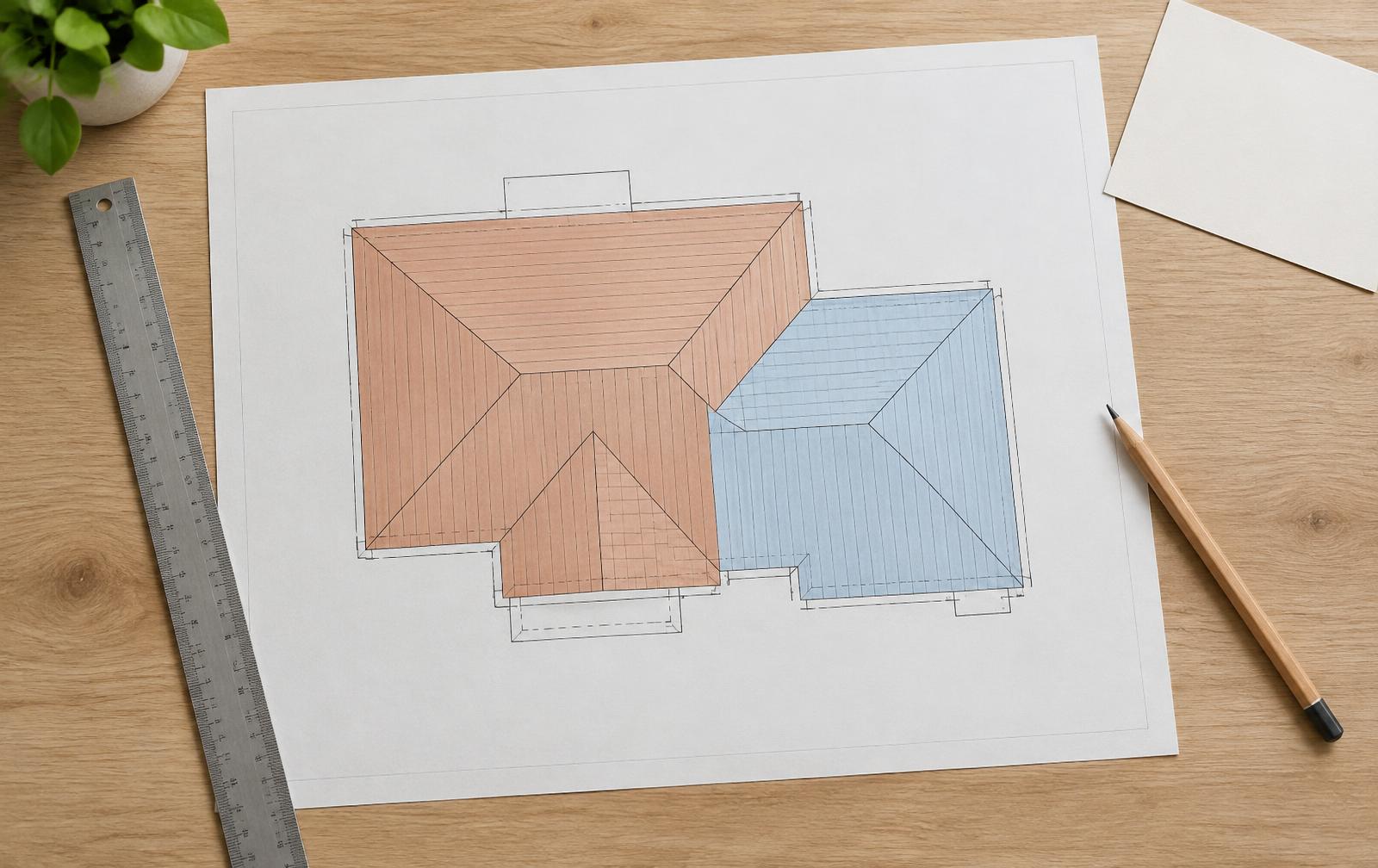
Ask for a roof plan with letters on each face or section. Match each defect photo to a letter. Then have the roofer mark the proposed work with a clear border. The drawing can be simple. It only needs to show what belongs to this job and what remains outside it.
At each border, ask how the new roof work connects to the part that stays. A valley is the low joint where roof faces meet. Flashing protects joints and roof openings from water. The planned edge may meet either one. Ask how that joint will be built. Does it call for related work?
Do not insist on the smallest possible patch just to keep a percentage low. Ask for a scope that solves the known problem. It must also meet the product rules and city codes. If two roofers choose different borders, have each explain why. The answers may show that the methods differ. A price gap alone would not explain that.
Keep appearance and function as separate choices
New material may not look exactly like the roof that stays. Ask for the exact product name and a sample where available. Look at it in normal daylight from a safe ground-level spot. A phone photo or tiny online swatch may not show the choice as you will see it at home.
Ask the roofer to state what is being matched: shape, size, color, or product type. An exact match may be out of stock or no longer made. Ask which other choices will work. A close color match tells you about looks. It does not prove that the products work together. The roof team should check the technical fit.
If you want more work for a more even look, label that as your added choice. Keep it separate from the work needed to address the defect. That helps you see why the scope grew. The roofer and city can review the revised plan. Do that before the larger job begins.
Make room for a deck inspection
The city's roof page calls for a final inspection. It also calls for a deck inspection when that step applies. It says the permit must be approved and posted before work. Contractors must also be registered. Confirm the current booking method and required pauses for your job.[R1]
Ask the roofer to put any deck-check pause in the work plan. Who requests the visit? What must remain visible? What happens if the inspector cannot attend when expected? The contractor should plan safe protection. Have them agree on the next work step with the city. A tight schedule should not hide a required check.
GAF sets base requirements for each shingle product. The cited product guide requires a suitable, dry deck. The right instructions depend on the product used. Ask the roofer to identify those instructions for your job. Do not use a generic thickness from the internet to direct deck repairs.[M2]
Use a change note when the job grows
Partial work is easiest to track when each change has a location. Ask the roofer to mark newly found damage on the same plan. Request photos of the new findings. Ask why the first repair limit is no longer enough. Then ask for the new area and updated price.
Find out if the city needs to review the change. Avoid a vague note such as extra wood as needed. You should be able to tell what was added, why it was added, and who approved it. The roof replacement guide helps if the evidence leads to a much larger roof decision.
You may be hard to reach during the job. Choose a backup contact in advance. Set clear limits on what they can approve. Ask how the crew will keep the site safe while approval is pending. Hidden conditions are a risk to plan for. They are not a reason to approve all extra work in advance.
Plan the join between today's work and later work
You may want to repair one part now and review another later. Ask the roofer to explain the limits of that plan. Does the first phase create work that would be removed in a later phase? Does it leave a roof joint that needs a special detail? Ask for the answer before setting a budget for each phase.
Do not assume that splitting the dates splits the city's review. Show the city the intended overall project where it is known. Ask how it wants the phases described. A staged budget is a planning choice; it is not a reason to hide the full scope.
Also decide what would trigger a fresh roof check. That may be a new leak, new storm concerns, or a condition named in the inspection report. Ask for the recommended follow-up in writing. The roof inspection guide explains the report. Use it to plan your questions.
Give a shared building a clear approval chain
If the roof covers space owned or managed by more than one party, first find who can approve work. A resident may report the leak. An owner or a board may be in charge of the roof. Check who has that right, even when a quote feels urgent. Check the building records and ask its manager.
Ask for a plan that uses the whole building's roof labels. Room numbers, suite numbers, and roof sections should connect in a way the project team can follow. Do not send a crew a vague report that says only back roof if several units share that edge.
For a business property, use a qualified roof professional. They need to know that type of roof. Ask the city which commercial requirements apply. The commercial roof inspection page has its own owner checklist. This residential guide does not set rules for a shared low-slope roof or settle ownership rights.
Track the repaired part after the work
Ask for a final marked plan. It should show where work was actually done. Keep it beside the scope you approved. The final area may differ. Ask why it changed and what the city says about it. That helps when the job grew during work. Old roofing can hide the true scope.
After work, report any new stain with its room location and date. Do not climb up to check the repair edge yourself. Give the roof team enough detail to trace the concern. A new leak report needs a fresh check. Do not assume that the first patch or a storm caused it.
Common questions
- Is exactly twenty-five percent exempt?
- The official pages do not use the same boundary wording. Ask Building Inspection before relying on an exemption. Give it the measured scope and ask how to count the roof area for that job. This page cannot resolve that city interpretation for you.
- Can I use the living area from a property listing?
- That figure measures something else. Request an actual roof-area measurement from the project team. Keep the roof surface, repair area, and material order apart. Then you can see which figures were used.
- Does needing a permit mean I need a whole new roof?
- A permit decision and a repair choice answer different questions. Ask what findings support the proposed scope. City review does not by itself show that every roof face needs replacement.
Next step
Read official requirements and prepare the scope questions. This is not a roofing lead form or booking.
Check the city roof guidance(opens official site in a new tab)Sources
- [R1] Richardson roof repair and replacementLimit: Residential city roof page; exact boundary conflicts with the city FAQ.
- [R2] Richardson Code Enforcement FAQLimit: Shows a conflicting boundary with R1, not a resolved interpretation.
- [R3] Richardson adopted codes (dated 2023-04-24)Limit: Background check only. Older system-page code lists are not used as current authority.
- [R4] Richardson contractor registrationLimit: Process verification only; no provider endorsement.
- [M2] GAF Camelot II installation instructionsLimit: One named product used only as an example of why exact instructions matter.
Sources checked October 5, 2026. Confirm current rules with the city before work starts.