Commercial · For owners & managers
Commercial Roof Leaks in Dallas: Finding Water on Big Roofs
Quick answer
On a big business roof, water can travel far under the roof before it drips. Keep people safe, protect stock, and keep a leak log. Then a roofer works from the drip point uphill, checks air units and walls, and uses meters or small test cuts to find hidden water. The goal is to find the real entry point, not just cover the closest hole.
What this page covers
This page is about active or repeat leaks on business buildings. It is for owners, managers, and staff who need to find where water gets in.
If you already know the problem and want to plan repairs, see our commercial roof repair page. If you need to map hidden wet areas across a whole roof, see our page on moisture surveys. If there is danger right now, see our emergency commercial roof page.
Safety comes first
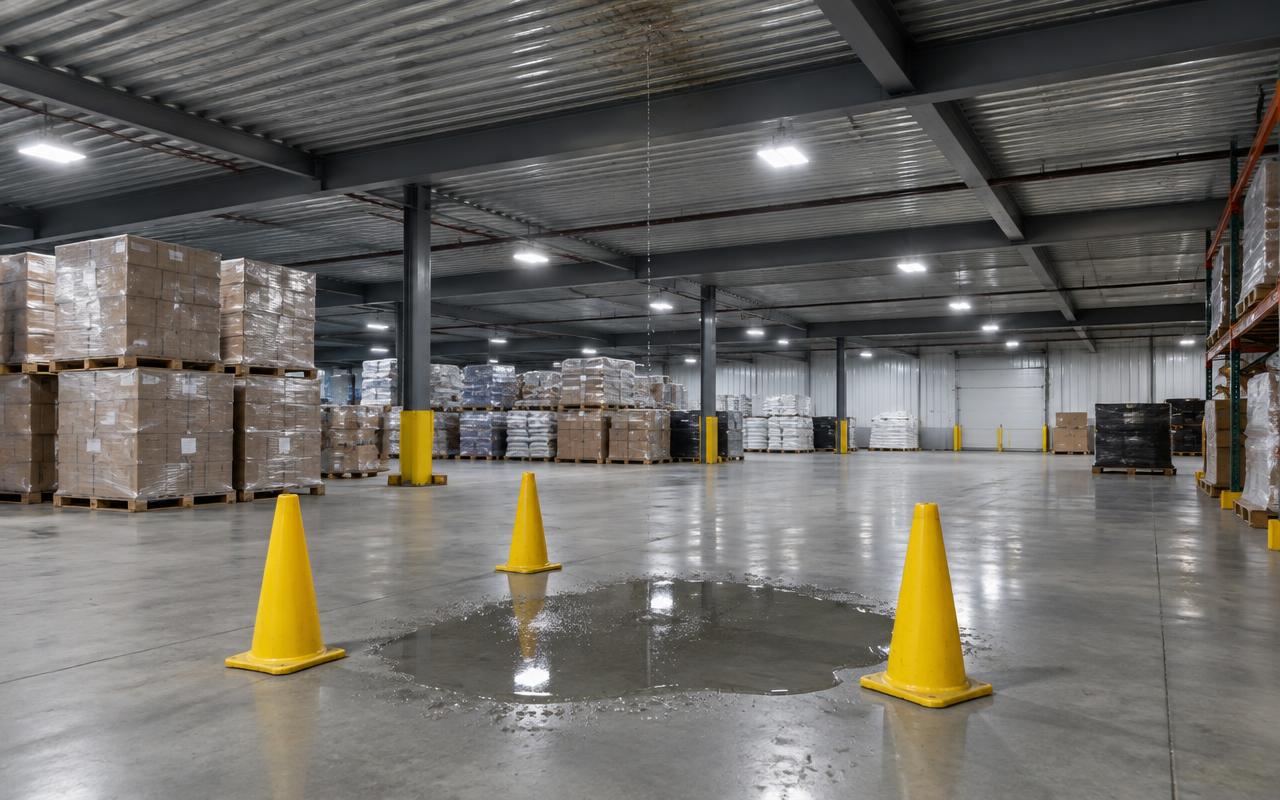
Water on the floor is a slip hazard. Put out cones or signs and keep people away from wet spots.
Stay away from water near lights, panels, or machines. If someone can reach the right breaker from a dry, safe place, they may shut off power to that area. If that is not safe, call an electrician or emergency help.
Do not send staff onto the roof during a storm or when it is wet. Roofs can be slick, and skylights can break under a person's weight. Only trained people with fall safety gear should go up, and only when it is safe.
Protect stock and equipment
Quick action inside can save a lot of money:
- Move stock, files, and machines away from the drip.
- Cover things you cannot move with plastic sheets.
- Set out large bins or catch basins under drips.
- Take photos of the leak and any damage.
- Mark each drip spot on a floor plan.
These steps also help with insurance, since they show you acted quickly.
Start a leak log
A leak log is a simple list of each leak. It is one of the most useful tools you have.
For each leak, write down:
- The date and time
- Where the water showed up
- How hard it was raining
- Which way the wind was blowing
- How long after the rain began the drip started
Patterns jump out fast. For example, you may find a leak only happens in rain from the south. That points the roofer to one side of the roof.
Why water travels on big roofs
Many business roofs are low-slope, which means nearly flat. The top sheet is called the membrane. Under it, there is often foam board called insulation, and under that is the deck.
When water gets through the top sheet, it can run along the foam or the deck for a long way. It may follow the slope or a seam. Then it drips out somewhere else.
That is why the drip spot is often not the leak spot. A roofer has to work backward from the drip.
Is it the roof or something else?
On business buildings, many leaks are not roof leaks. Check these before blaming the roof:
- Air units can leak from their own panels or drain lines.
- Drain pipes inside the ceiling can crack or clog.
- Walls and windows can let water in during wind-driven rain.
- Cold pipes and ducts can sweat on humid days.
- Fire sprinkler lines can drip.
If the drip sits right under an air unit, ask an air conditioning tech to check the unit too. A joint visit can save time and blame.
How a roofer traces a leak
A careful roofer follows a clear plan:
- Read your leak log and floor plan.
- Look at the ceiling and deck from inside, if possible.
- Go to the roof spot above the drip.
- Check the closest details first, like curbs, pipes, and seams.
- Then work uphill along the slope.
- Use a moisture meter to find wet spots under the sheet.
- Cut a small test hole if needed, then patch it.
- Fix the cause and watch through the next rain.
A curb is the raised box under an air unit. A test hole is also called a core cut. It shows what is inside the roof layers.
Common leak spots on business roofs
These are spots that often fail:
- Flashing at air unit curbs, which is the seal up the side of the box
- Seams where two sheets join
- Pipe seals and pitch pans, which are small cups filled with sealant
- The top of low walls around the roof, called coping
- Drains with loose rings or cracked bowls
- Skylights and roof hatches
- Punctures from dropped tools or foot traffic
Each of these has its own repair method. The fix must match the roof type.
Leaks along outside walls
If water shows up along an outside wall, the low wall around the roof may be the cause. This wall is called a parapet.
Water can get in through gaps in the metal cap on top of the wall. It can get in through cracks in brick or block. It can also get in where the roof sheet turns up the wall.
A good roofer tests the wall cap and the wall itself, not just the roof. Sometimes a mason is needed to fix the wall.
When hidden water is spread out
Sometimes a leak has gone on for a long time. Water may have soaked large parts of the foam below.
Wet foam does not dry under a sealed roof. It gets heavy and stops keeping heat out. It can also damage the deck.
If a roofer finds wet foam in many places, ask about a moisture survey. It maps the wet areas across the roof. Then you can make a smart choice between repair, coating, or a new roof.
Fix the cause, then watch
After a repair, keep your leak log going. If the drip stops in the next few rains, the cause was likely found.
If it comes back, tell the roofer right away. Share your log. A good roofer will come back and keep looking.
It is normal for a tricky leak to take more than one visit. It is not normal for a roofer to keep patching without explaining what they found.
Drainage and repeat leaks
Water that sits on a roof for days is called ponding. It makes leaks more likely and wears down some roof types faster.
GAF, a large roofing maker, points to drains, scuppers, and sloped foam boards as the main ways to move water off a roof. If a leak keeps coming back near a low spot, fixing the drainage may be part of the answer.
What drives the cost
We do not post prices. Each leak is different. These things change the cost:
- How big the roof is and how long tracing takes
- Tools needed, like moisture meters or test cuts
- Working with air conditioning techs or masons
- How easy the roof is to reach
- Inside protection and cleanup
Ask for a written list of what the price covers. Ask how a return visit is handled if the leak comes back.
Questions to ask a roofer
- How will you trace water on a roof this size?
- Will you work with our air conditioning company if needed?
- Do you use moisture meters or test cuts?
- What happens if your first repair does not stop the leak?
- Will you mark the leak spots and repairs on a roof map?
- Will you send photos of what you found?
These questions help you pick someone who looks for causes, not just quick patches.
Leaks after storms
After hail or high wind, new leaks can show up on a business roof. Hail can crack some roof sheets, and wind can lift edges and metal caps.
Look for new drips, dented air units, and bent metal along the roof edge. Take photos from the ground and from inside. Write down the date of the storm.
Your insurance company decides what is covered. The Texas Department of Insurance says a roofer working on your building cannot act as your public adjuster. A roofer can document what they find, which is useful for your records.
Temporary fixes
Sometimes a full repair cannot happen right away. A roofer may put on a short-term patch to slow the water.
A short-term patch is fine as long as everyone knows it is short-term. Ask the roofer to mark it on the roof map and in the report. Then plan the lasting repair soon, before the patch wears out.
Keep people informed
Staff and tenants often worry when they see leaks. A short note helps. Tell them where the leak is, what areas to avoid, and when help is coming.
Do not promise a fix date until the roofer has found the cause. A clear and honest message builds trust, even when the answer is that the search is still going.
Leaks over sensitive spaces
Some rooms need extra care when water comes in. Server rooms, labs, clinics, kitchens, and storage for food or medicine can all be harmed by even small drips.
If a leak is over one of these spaces, tell the roofer right away so it goes to the top of the list. Ask about short-term covers inside the room, such as plastic sheets and catch pans, to protect what is there while the roof is fixed.
Where the drip is and where to look
| Where the drip is | Where to look first |
|---|---|
| Right under an air unit | The curb seal and the unit itself |
| Along an outside wall | The wall cap, the wall, and where the roof turns up |
| Far from any pipe or unit | Water may be traveling under the roof sheet |
| Only in wind from one side | Details on that side of the roof |
| On dry, humid days | Sweating pipes or ducts, not the roof |
Common questions
- Why does the leak seem to move?
- Water follows the slope and seams under the roof. Where it drips can change with how hard it rains.
- Should staff go on the roof to look?
- No, not in a storm or when wet. Only trained people with fall safety gear should be on the roof.
- Can a leak be found without cutting the roof?
- Often yes. Meters and careful checks find many leaks. A small test cut is sometimes needed, and it is patched right after.
- Is a leak near lights dangerous?
- Yes. Keep people away. Only shut off power from a dry, safe spot. Otherwise call an electrician or emergency help.
- What if the leak only happens at night?
- Some leaks show up hours after rain stops, because water travels slowly under the roof. Others come from air units that run more at certain times. Note the hour in your leak log, since that pattern helps the roofer narrow down the cause.
- Can a leak cause damage we cannot see?
- Yes. Water can soak foam boards, rust steel deck, and wet the back of ceiling tiles long before you see a drip. That is why finding the cause quickly matters, even for small leaks.
What happens if you send a request here
This site is a preview. The request form is not connected, so nothing you type is saved or sent. No local roofing partner is confirmed yet, so we cannot promise a visit, a price, or a time. If anyone is in danger, call 911. How this site works.
Sources
Sources checked October 5, 2026. Confirm current rules before acting.