Commercial · For owners & managers
Commercial Roof Repair in Dallas for Owners and Facility Teams
Quick answer
Commercial roof repair is planned work on a business roof. It fixes known problems while the building stays open. A good plan checks the warranty first, keeps staff and customers safe, and leaves you with photos and a marked roof map. Track repairs over time so you know when to budget for something bigger.
What this page covers
This page is for owners, property managers, and facility teams. It is about planning and managing repairs on a business roof of any type.
If water is coming in right now and nobody knows why, start with our commercial roof leak page. If you want details on how flat roof patches work, see our flat roof repair page. If there is danger right now, such as a big opening in a storm, see our emergency commercial roof page.
Why business roofs are different
A leak at home is a hassle. A leak at a business can stop work. It can soak stock, shut down a room, or create a slip hazard for customers.
Business roofs are also bigger. They often have air units, pipes, vents, skylights, and signs on top. Each one is a spot where the roof can fail.
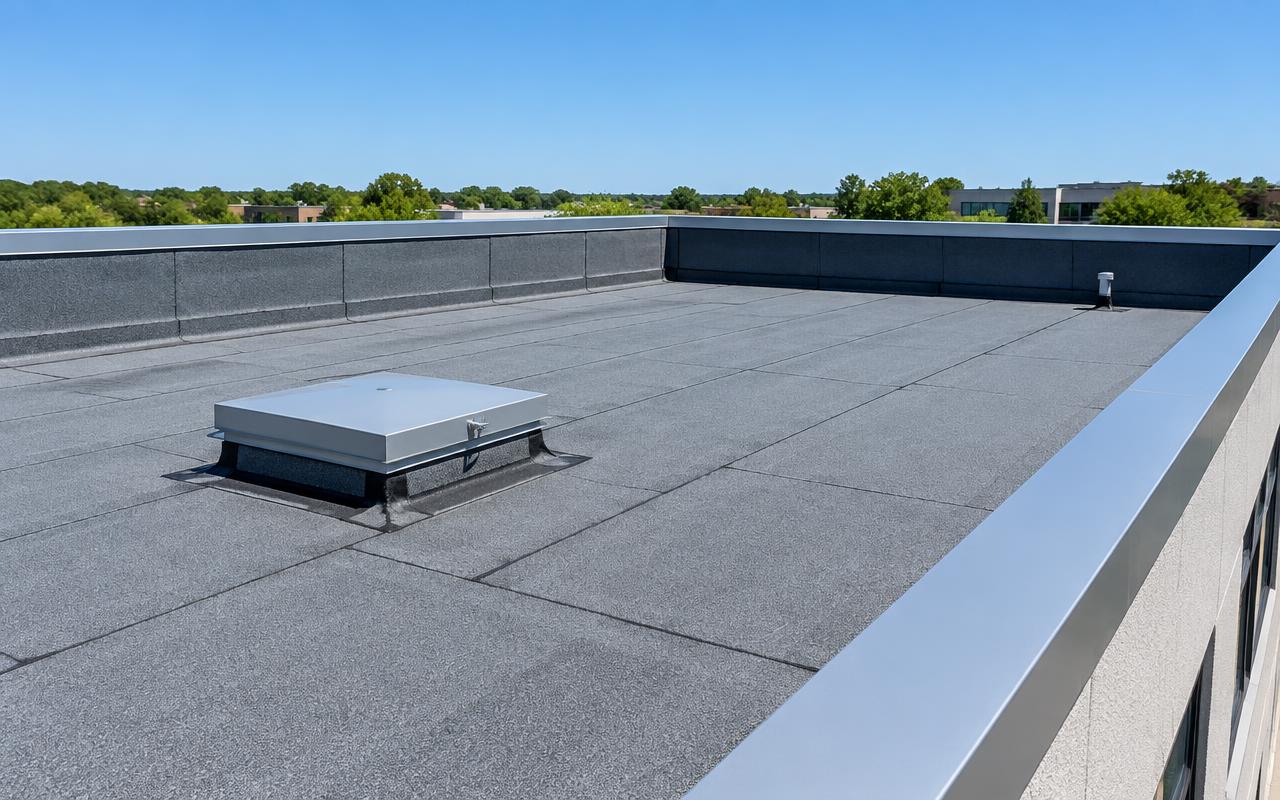
Many business roofs are low-slope, which means nearly flat. They use big sheets or rolled layers instead of shingles. Repairs must match that type of roof.
You do not need to know the roof type
Many owners do not know what kind of roof they have. That is fine. A roofer can figure it out.
What helps most is simple facts you already know:
- What the building is used for
- Where water shows up inside, and when
- How to get onto the roof, such as a hatch, ladder, or lift
- Whether there is a warranty on the roof
- What hours work can happen
- Who on site should be told before work starts
Have these ready, and the first visit will go much faster.
Check the warranty first
Many business roofs come with a warranty from the roof maker. A warranty is a written promise that covers certain problems for a set time.
Some warranties say only approved roofers may work on the roof. Some require certain repair materials. If the wrong person cuts into the roof, the warranty could be harmed.
Before any repair, find the warranty papers. Look for who to call and what the rules are. If you cannot find them, ask the company that put the roof on, or ask the maker.
Plan around people and operations
Repairs on a working building need a plan that goes beyond the roof itself. Talk through these points before the work date:
- The safe path to the roof, and who holds the keys
- Where tools and trash will be stored
- Glue and coating smells near rooftop air intakes
- Noisy work and quiet hours for offices, clinics, or hotels
- Notices for staff and tenants
- Parking for work trucks and space for a lift
Air intakes are vents that pull outside air into the building. If strong smells drift in, people may complain or feel sick. Ask how the roofer will handle this.
What a good repair visit includes
A careful roofer follows a clear order on a business roof:
- Gather the roof map, age, roof type, and warranty facts.
- Walk the whole roof, not just the problem spot.
- Mark each problem on a roof map.
- Check seams, edges, curbs, and drains near reported leaks.
- Test soft spots to see if the layer below is wet.
- Make a list of repairs, sorted from most to least urgent.
- Do the work, then take photos of each repair.
A curb is the raised box that holds an air unit. Seams are where two roof sheets join. Both are common leak spots.
The paperwork you should get
Good records save money later. After each visit, you should get:
- Dated photos from before and after
- A roof map with each repair marked
- A list of what was fixed and what materials were used
- Notes about anything that needs to be watched
Keep these in one folder for each building. They help with budgets, warranty claims, and the next roofer who comes out.
Water that will not drain
On low-slope roofs, water that sits for days is a big cause of repeat leaks. This is called ponding.
GAF, a large roofing maker, says drains, scuppers, and sloped foam boards are the main ways to move water off a roof. Scuppers are openings in the wall that let water out. Sloped foam boards are called tapered insulation.
If the same spot leaks over and over, ask whether water is sitting there. Fixing the drainage may stop the repeat repairs.
Other trades on your roof
Air conditioning workers often go on the roof more than roofers do. Tools get dropped. Panels get left open. New pipes get added without proper seals.
A few simple steps can help:
- Keep a sign-in sheet at the roof hatch.
- Ask the roofer to check the roof after any air unit is replaced.
- Put down walk pads, which are thick mats, on paths to the equipment.
- Ask other trades to call before they cut into the roof.
These steps cut down on surprise holes and arguments about who caused them.
Track your repairs over time
One repair is normal. A rising number of repairs on the same roof is a signal.
Keep a simple list for each roof with the date, the spot, and the repair. Look at it once a year.
If repairs climb year after year, it may be time to budget for a coating or a new roof. Planning ahead lets you pick the timing, instead of being forced by a big failure.
When a repair is not enough
Repairs make sense when problems are few and the roof below is dry. They make less sense in these cases:
- Wet foam boards cover large parts of the roof.
- The roof sheets are loose or pulling away in many areas.
- Repairs keep failing in new spots.
- The roof is near the end of its expected life.
If you see these signs, ask for a moisture survey. It is a test that maps where water is hiding under the roof. Then you can compare a coating, a new roof over the old one, or a full tear-off.
What drives the cost
We do not post prices. Real prices depend on your building. These things make repairs cost more or less:
- The roof type and the repair materials it needs
- How easy and safe it is to reach the roof
- Whether a lift or crane is needed
- Night or weekend work to avoid disrupting business
- Wet foam found during the repair
- Warranty inspection rules
Ask for a written list of what the price covers. Ask how surprises will be priced.
Questions to ask a roofer
- Will this repair affect our warranty?
- Will you give us a marked roof map and photos?
- How will you protect the roof from your own crew's foot traffic?
- How will you handle smells near our air intakes?
- What will you do if you find wet foam under the roof?
- Can you sort the repairs by how urgent they are?
Clear answers to these questions show the roofer plans for your business, not just the roof.
Different roofs, different repairs
Business roofs come in many types. A white sheet with heat-melted seams is repaired by cleaning the area and melting a new patch on with a hot air tool. A rubber sheet is repaired with special tape and primer, not heat.
A mod-bit roof, a thick rolled sheet of asphalt mixed with rubber or plastic, is often patched with matching rolled sheet. A metal roof may need new screws, seam sealant, or a new panel.
If the patch does not match the roof, it can peel off. Ask the roofer to name your roof type and the exact patch they plan to use. Ask how they will test it once it is done.
Safety rules for roof work
Business roofs often have skylights, open edges, and hatches. These are serious fall risks. A good roofer brings fall safety gear and follows a safety plan.
Ask what safety steps the crew will take. Ask whether they need you to block off any areas below. If the building has its own safety rules, share them before the work date so the crew can plan.
Never let untrained staff walk the roof to check on the work. If you need to see the results, ask for photos or go up with the roofer using proper gear.
Repairs and your budget
Repairs are usually paid from a yearly upkeep budget. Bigger fixes, like a coating or new roof, are often paid from a long-term budget.
Your repair records help you know which kind of money you will need and when. Share them with the person who plans spending. A clear history makes it easier to explain why a bigger fix is coming.
Choosing who to call
Look for a roofer who works on your roof type and on buildings like yours. Ask for proof of insurance before anyone goes on the roof.
If your roof has a maker's warranty, ask the maker for a list of approved roofers in the area. Using an approved roofer helps protect the warranty, and they often know that roof system well.
Repair signals for a business roof
| What you see | What it usually means |
|---|---|
| A few small problems on a dry roof | Repairs are a good fit |
| More repairs each year on the same roof | Start budgeting for a bigger fix |
| Large areas of wet foam below the roof | Repairs will only buy a little time |
| The roof has a maker's warranty | Call the warranty holder before any work |
| Leaks right after air unit work | Check the curb and seals around that unit |
Common questions
- Can repairs happen while we are open?
- Often yes. Plan the path to the roof, smells near air intakes, noise, and notices for staff before the work date.
- How often should a business roof be checked?
- Many owners check twice a year and after big storms. Some warranties set their own schedule, so read yours.
- Who is responsible for holes made by other trades?
- It depends on your contracts. A sign-in sheet and a roof check after each job make it easier to know.
- Can one plan cover several buildings?
- Yes. Using the same report format for each building makes it easier to compare roofs and plan budgets.
- Should we fix small problems or wait for a new roof?
- If a new roof is more than a year or two away, small repairs usually make sense. They keep water out of the foam boards, and dry boards may let you choose a cheaper option later, such as adding a new roof over the old one.
- What is a pitch pan?
- A pitch pan is a small metal cup around an odd-shaped pipe or support that goes through the roof. It is filled with sealant. Over time, the sealant shrinks and cracks, so pitch pans need to be checked and topped off.
What happens if you send a request here
This site is a preview. The request form is not connected, so nothing you type is saved or sent. No local roofing partner is confirmed yet, so we cannot promise a visit, a price, or a time. If anyone is in danger, call 911. How this site works.
Sources
Sources checked October 5, 2026. Confirm current rules before acting.