Commercial · For owners & managers
Flat Roof Repair in Dallas: Seams, Drains, and Flashing
Quick answer
Flat roofs often leak at the edges, seams, drains, and spots where pipes go through. A good repair finds the weak spot, uses the right patch for that roof, and fixes any water that sits too long. If the layer under the roof is soaked, a patch only buys time.
What a flat roof is
A flat roof is not truly flat. It has a small tilt so water can run off. People also call it a low-slope roof.
The top layer is the part that keeps water out. Roofers call it the membrane. Think of it like a big raincoat for the building.
Under the raincoat there is often a layer of foam boards. That layer is called insulation. It helps keep heat out in summer.
Under that is the deck. The deck is the hard floor of the roof. It may be wood, steel, or concrete.
When a flat roof fails, any of these layers can be part of the problem. That is why a quick look is not always enough.
Where flat roofs leak most
Flat roofs almost never leak in the wide open middle first. They leak at the details. A detail is any spot where the roof changes or something pokes through.
- Seams, where two sheets of roof meet
- Edges, where the roof meets a wall or the side of the building
- Curbs, which are the boxes that hold air units
- Pipes and vents that go through the roof
- Drains and scuppers, which are holes in the wall that let water out
- Old patches that were not done the right way
If you know where water shows up inside, start by looking at the details above that spot. Then look uphill, since water can travel.
Water that will not drain
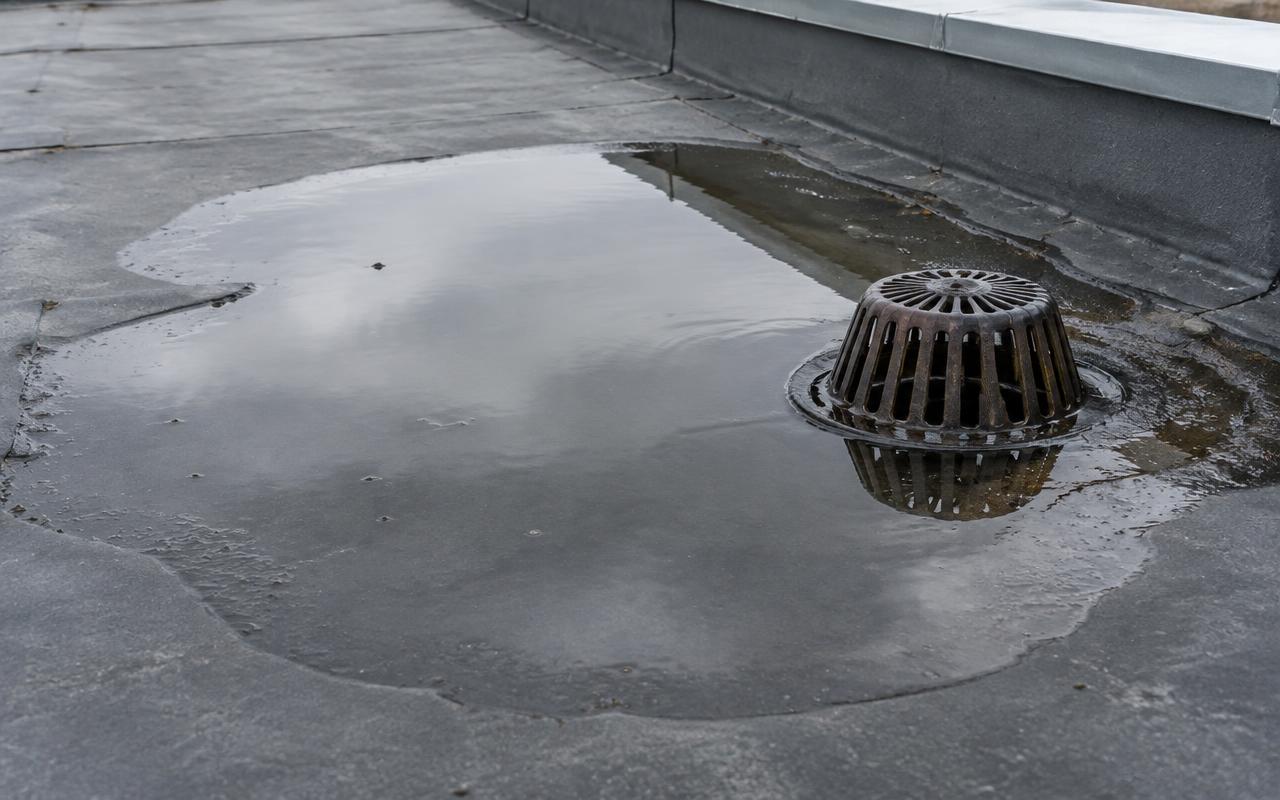
Water that sits on a roof long after rain is called ponding. A small puddle that dries soon after rain is usually less worrying. Water that stays for days is a warning sign worth having checked.
Standing water adds weight. It also wears down some roof types faster. It can hide small holes, too.
GAF, a large roofing maker, says drains, scuppers, and sloped foam boards are the main tools to move water off a roof. Sloped foam boards are called tapered insulation. They are thicker on one side, so water rolls toward a drain.
Here is the key point. If a leak sits in the same low spot every time, patching the hole is not enough. The water has to be moved, or the patch will fail again.
Know your roof type first
There are many kinds of flat roofs. Each one is fixed in its own way. A patch made for one kind may not stick to another.
- TPO is a white sheet. Its seams are melted together with heat.
- PVC is also a sheet with heat-melted seams. It handles grease well.
- EPDM is a rubber sheet. It is often black, but it can be white. Its seams use tape or glue.
- Mod-bit, short for modified bitumen, is a thick rolled sheet. It is made of asphalt mixed with rubber or plastic to help it bend.
- Built-up roofs stack many layers of asphalt and felt sheets, often with gravel on top.
- Some roofs have a liquid coating painted over the top.
Carlisle, a maker of TPO, PVC, and EPDM, lists these sheets as separate products with their own rules. Ask your roofer to name your roof type and to say what repair material matches it.
Signs you can spot from inside
You do not need to climb on the roof to help. In fact, please do not. Flat roofs can be slick, and edges are a fall risk.
Look for these signs from inside the building:
- Brown rings or stains on ceiling tiles
- Drips that start an hour or more after rain begins
- Wet spots along an outside wall
- Musty smells in one area
- Ceiling tiles that sag or feel soft
Write down the date, the time, and how hard it rained. Note the wind, too. This log helps a roofer find the leak much faster.
How a good repair visit works
A careful repair visit has a clear order. It should not be a quick dab of goop.
- First, the roofer names the roof type.
- Next, they check the drains and look for standing water.
- Then they look at the seams near the leak.
- They check the edges, curbs, and pipes close by.
- If the roof feels soft, they test for wet layers below.
- They clean the area, then use a patch that matches the roof.
- Last, they take photos and tell you what they did.
With heat-welded roofs, a good roofer tests the new seam with a small probe tool. With rubber roofs, they check that the tape edges are tight and smooth.
When the layer below is wet
Sometimes water gets under the top sheet and soaks the foam boards. This can happen with a small leak that went on for a long time.
Wet foam does not dry out on its own under a sealed roof. It stays wet. It gets heavy. It stops keeping heat out.
A roofer can find wet areas in a few ways. They may use a meter that senses water. They may cut out a small sample. On some roofs, a heat camera at night can show wet spots.
If only a small area is wet, the roofer can cut it out and replace it. If large areas are wet, repairs will not last long. That is when you should talk about bigger options.
Repair, coat, or replace
There are three main paths for a flat roof that has problems. The right one depends on the facts, not on what is easiest to sell.
A repair fixes one spot or a few spots. It makes sense when the rest of the roof is dry and still attached well.
A coating is a thick liquid rolled or sprayed over the whole roof. GAF's coating guide says the roof must be dry, clean, and tested before it is coated. Wet foam must be removed first. Drainage problems must be fixed first, too.
A full replacement removes the old roof or adds a new one over it. It makes sense when the roof is worn out or wet in many places.
If someone offers a coating without testing for wet areas, ask why.
What drives the cost
We do not post prices. Real prices depend on your roof. Here are the things that make a repair cost more or less:
- How easy it is to get onto the roof safely
- The roof type and the patch material it needs
- How many spots need work
- Whether drains need to be fixed or added
- How much wet foam must be cut out
- Whether the work must happen at night or on weekends
- Rules from your roof warranty, if you have one
Ask for a written list of what is in the price. Then you can compare one bid to another.
Warranties and who can work on the roof
Some flat roofs come with a warranty from the maker. A warranty is a written promise about the roof.
Many of these warranties say only approved roofers may work on the roof. If the wrong person cuts into it, you may lose your warranty.
Before any repair, find your warranty papers. Read who to call. If you are not sure, ask the maker. It is a short call that can save a big problem later.
Questions to ask before work starts
Good questions help you spot good work. Here are some to ask:
- What type of roof do we have?
- What patch material will you use, and does it match?
- How will you test the repair when it is done?
- Will you also fix the spot where water sits?
- Do you think the layer below is wet? How will you check?
- Will this work affect our warranty?
- Will you send photos from before and after?
A good roofer will not mind these questions. Clear answers are a good sign.
Who this page is for
This page is for anyone with a flat roof. That includes homes with flat sections, shops, offices, and warehouses.
If you run a business and need help planning repairs around staff and customers, see our page on commercial roof repair. If water is coming in right now and you do not know why, see our page on commercial roof leaks.
If you are thinking about a coating for the whole roof, read our page on roof coatings first. It explains when a coating can help and when it cannot.
Safety while you wait for help
If water is dripping inside, move people, stock, and equipment away from the wet area. Put down a bucket or a tarp to catch water so floors do not get slick.
Stay away from water near lights, outlets, or electrical panels. If you can reach the breaker panel from a dry, safe spot, you may turn off power to that area. If you cannot do that safely, call an electrician or emergency help instead.
Do not go up on the roof during a storm or while it is wet. A flat roof can feel safe, but wet sheets are slick, and edges and skylights are easy to fall through. Wait until a trained person can go up with the right safety gear.
Homes with flat sections
Many Dallas homes have a flat part over a porch, a back room, or a garage. These small flat areas often leak where they meet the sloped roof or the wall of the house.
Shingles are not made for very low slopes. If someone put shingles on a nearly flat porch roof, water can slip under them in heavy rain. A low-slope sheet or rolled roof is usually the better choice for that spot, and a roofer can explain the options.
Flat roof signs and the usual fix
| What you see | What it usually means |
|---|---|
| Leak near one pipe or curb, roof dry elsewhere | A spot repair is often enough |
| Water sits in the same low spot after every rain | Fix the drainage, not just the hole |
| Soft or spongy feel in one area | The foam below may be wet; test first |
| Many old patches of different kinds | Ask if the patches match the roof |
| Leaks in many places at once | Talk about coating or replacement |
Common questions
- Is a little standing water okay?
- Water that dries within about a day or two after rain is common. Water that stays longer is ponding, and it should be looked at.
- Can I patch a flat roof myself?
- Flat roofs are a fall risk, and the wrong patch may not stick. It can also break a warranty. It is safer to let a trained roofer do it.
- Can a flat roof be fixed in winter?
- Many repairs can be done in cool weather. Some glues and coatings need warm, dry days. Ask what the product needs.
- How long does a flat roof repair last?
- It depends on the roof, the patch, and the cause. A repair that fixes the cause lasts longer than one that only covers a hole.
- Why does my flat roof leak only in big storms?
- Heavy rain can fill a low spot faster than the drain can empty it. The water then rises above a seam or flashing that stays dry in light rain. Clearing drains and fixing low spots often solves this kind of leak.
What happens if you send a request here
This site is a preview. The request form is not connected, so nothing you type is saved or sent. No local roofing partner is confirmed yet, so we cannot promise a visit, a price, or a time. If anyone is in danger, call 911. How this site works.
Sources
- GAF — Mitigating water on roofs
- GAF — Liquid-applied roofing manual
- Carlisle SynTec — TPO membranes
- Carlisle SynTec — PVC membranes
- Carlisle SynTec — EPDM membranes
Sources checked October 5, 2026. Confirm current rules before acting.