Commercial · For owners & managers
Emergency Commercial Roof Repair: What to Do Right Now
Quick answer
In a roof emergency at a business, protect people first, then equipment and stock. Keep staff off the roof during storms, keep everyone away from water near power, and log where water shows up. Once weather is safe, a trained crew can make a temporary fix to slow the water. The lasting repair comes after someone finds the real cause.
What this page covers
This page is for building owners, property managers, and facility teams when a roof problem cannot wait. Water may be pouring into a store, an office, or a warehouse. Part of a roof may have torn loose in wind.
If the leak is slow and you have time to plan, our commercial leak repair page fits better. If the storm has passed and you want to sort out what it did across the whole roof, see our commercial storm damage page.
The first hour: people and power
Move people away from the wet area. Block it off with cones or tape. Wet floors cause falls, and soaked ceiling tiles can drop.
Water and power do not mix. Keep everyone away from water near light fixtures, panels, or equipment. If your team can reach a shutoff from a dry, safe spot, and it is part of your building plan, they may use it. If not, call your electrician or emergency help. Do not let staff touch wet electrical gear.
Never send staff onto the roof during a storm, in high wind, or in lightning. Roof edges, skylights, and wet sheets are serious fall risks. Wait until the weather is safe and a trained crew with fall gear can go up.
The first hour: protect what matters
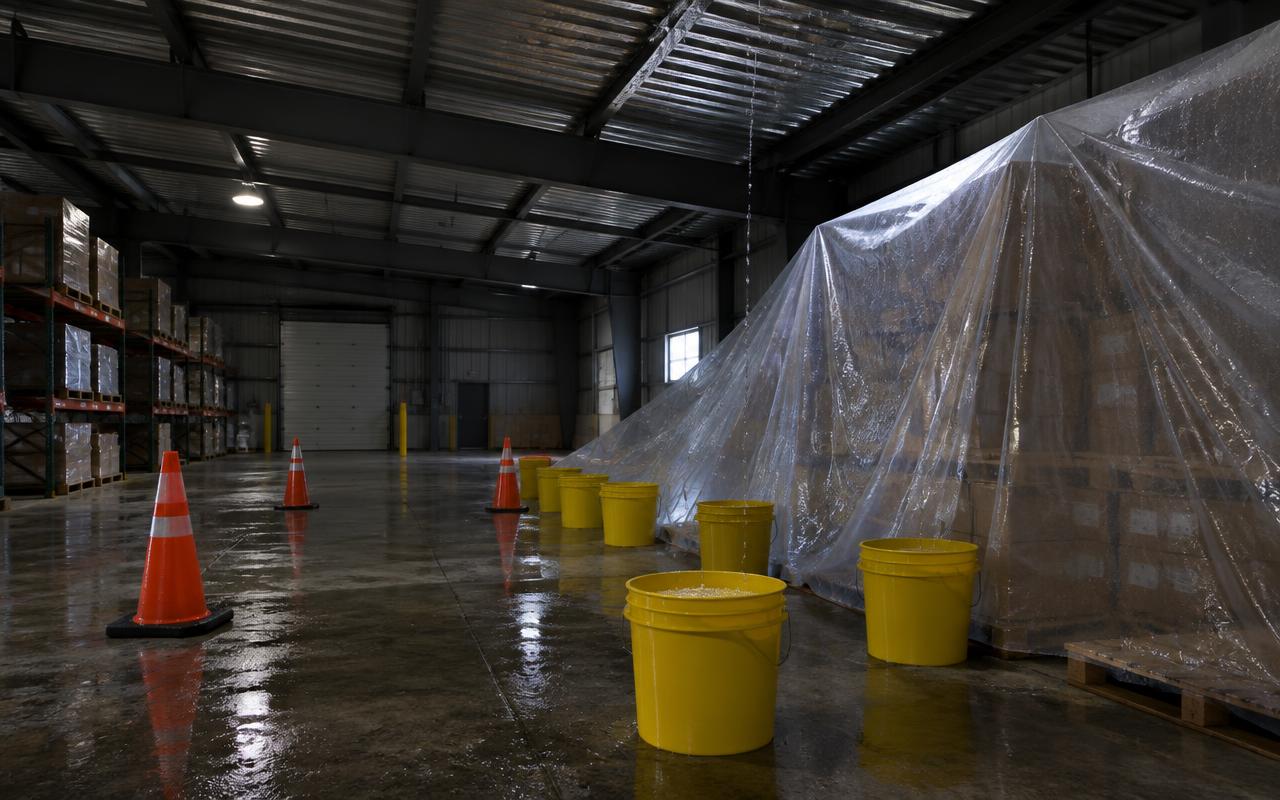
- Cover stock, records, and machines with plastic sheets.
- Move what you can away from drips.
- Put down catch buckets and pans.
- Take photos and video of the water and what it hit.
- Write down the time and place of each drip.
Some spaces need extra care. Server rooms, medical areas, food areas, and rooms with sensitive machines should get attention first. Tell the roofer about them right away.
Who to call and in what order
Make a short list now, before the next storm. Keep it where the night and weekend staff can find it.
- Emergency help, if anyone is hurt or there is a fire or power risk
- Your building's electrician, for anything involving wet power
- Your roofer, for the roof itself
- A water damage company, for drying the inside
- Your property manager or owner
- Your insurance agent, to report the loss
If your roof has a maker's warranty, check what it says about emergency repairs. Some require you to call an approved roofer or report the problem within a set time.
Temporary fixes a crew may use
Once the weather is safe, a crew can slow the water. These fixes buy time. They are not the final repair.
- Patching a torn area with a compatible temporary material
- Covering an open section with heavy sheeting held by weights
- Clearing a clogged drain or scupper so water can leave
- Resealing a lifted edge or flashing
- Diverting water away from a sensitive room inside the building
Ask the crew what they used and where. Some quick patches can make the later repair harder if the wrong material goes on the roof. Use a roofer who knows your roof type.
Clogged drains are a common cause
Flat roofs depend on drains and scuppers to move water off. GAF, a large roofing maker, explains that drains, scuppers, and tapered insulation are the main ways to move water off a low-slope roof.
When leaves or debris block a drain during a heavy rain, water can rise fast. It can back up over flashings and into the building. Too much standing water also adds weight.
Clearing drains is often the fastest way to help in an emergency. A crew should do it when it is safe to be on the roof.
Why the real cause can be far away
Water on a flat roof can travel under the top sheet before it drips into the building. The drip may be many feet from the opening.
A crew may use moisture meters, infrared cameras, or small test cuts to find wet insulation and trace the source. Test cuts should be made only by a trained crew and patched right away. Do not let anyone cut the roof without a plan to seal it.
Our commercial leak repair page explains this search in more detail.
Different roofs, different quick fixes
Single-ply roofs, like TPO and PVC, are often heat-welded at the seams, as Carlisle, a large maker, explains for its membranes. A temporary patch should not ruin the surface for a later weld.
EPDM is a synthetic rubber sheet. It uses its own tapes and primers, and patches must match it.
Mod-bit, short for modified bitumen, and built-up roofs use asphalt-based layers. Metal roofs may need new screws, sealant, or a panel. Using the wrong patch on any of these can cause trouble later.
Keep the business running
Emergency roof work can be loud, smelly, and in the way. Plan around customers and staff.
- Ask where the crew will stage tools and set up ladders.
- Keep walkways and fire exits clear.
- Ask about smells from any products and how to keep them out of air intakes.
- Plan noisy work for times the building is less busy, if the problem allows it.
- Name one person on your team to talk with the crew.
Records that help later
Keep a simple log for each emergency. Write the date, the time, where water came in, what was done, and who did it. Add photos and every invoice.
This log helps your roofer find patterns. It helps you decide later whether repairs still make sense or whether a larger project is coming. It also helps if you file an insurance claim.
Insurance roles
The Texas Department of Insurance says a roofer cannot act as a public adjuster for the policyholder or offer to cover the deductible. A roofer can document the damage and give you an estimate.
Your insurer decides coverage. If you want someone to deal with the insurer for you, that person must be a licensed public adjuster.
What drives the cost
We do not post prices. These things can change the cost of emergency work:
- After-hours, weekend, or holiday calls
- How big the open area is
- How hard the roof is to reach, and what lifts are needed
- The roof type and the materials it needs
- Inside protection and drying
- Whether many buildings in the area need help at the same time
After the emergency
Within days, have the roofer check the whole roof. Ask what caused the problem and whether other areas are at risk.
Then plan the lasting fix. That could be a repair, a larger section, or part of a replacement plan. Our commercial roof repair page helps with that choice. A maintenance plan can also lower the chance of the next emergency.
Plan before the next emergency
The best time to plan for a roof emergency is before one happens. Walk the building with your team and roofer once a year.
- Mark roof access points and keys.
- Note shutoffs for water and power, and who is allowed to use them.
- Mark rooms that need fast protection, like server or medical rooms.
- Keep plastic sheeting, buckets, and cones on site.
- Post the contact list where night and weekend staff can find it.
A short plan can save hours when water is coming in.
Roof access and keys
Crews lose time when they cannot get to the roof. Make sure the roof hatch or ladder is easy to reach and that keys are where staff can find them.
If the roof is reached by an outside ladder, keep the area clear. If a lift is needed, note that on your plan so the roofer knows to bring one.
Who pays for what
In an emergency, many costs come up fast. There may be roof work, drying, cleanup, and lost business time.
Keep every invoice and note what each one was for. Your insurance policy explains what it covers. Your lease may say whether the owner or tenant pays for certain work. Sorting this out is easier with good records.
Common emergency causes on business roofs
Many roof emergencies come from a short list of causes. Knowing them helps you plan.
- Clogged drains and scuppers during heavy rain
- Edge metal pulled loose by wind
- Punctures from dropped tools or falling limbs
- Seams that open on an aging roof sheet
- Flashing that pulls away around rooftop units
- Skylights cracked by hail or debris
Regular checks can catch many of these before a storm turns them into an emergency.
Drying the inside
Once the roof is covered, the inside needs to dry. Wet ceiling tiles, carpet, drywall, and insulation can grow mold if they stay damp.
A water damage company can measure moisture and set up fans and dryers. Ask them to share their readings. Some materials can be dried. Others need to be removed. Keep records of what was removed and why.
Practice makes it faster
Once a year, walk through your emergency plan with the people who would use it. Ask the night manager to find the contact list and the roof keys. Ask where the buckets and plastic sheets are stored.
Small gaps show up fast in a practice run. Fix them while the sky is clear.
Emergency signs and first moves
| What you see | First move |
|---|---|
| Water near power or equipment | Keep people away; call qualified electrical help |
| Ceiling tiles sagging | Clear the area below |
| Water rising fast on the roof | Get a crew to clear drains once it is safe |
| Roof edge peeled back by wind | Keep people away from the building edge below |
| Slow drips in one spot | Catch water, log it, and plan a leak search |
| Water in a server or medical room | Protect it first; tell the roofer |
Common questions
- Can our maintenance staff go up during the storm?
- No. Wait until wind and lightning pass and a trained crew with fall gear can go up safely.
- Is a temporary patch enough?
- No. It slows water for now. The lasting repair needs a full check and the right materials for your roof.
- Will a temporary fix hurt my warranty?
- It can, if the wrong material is used. Check your warranty and call an approved roofer when possible.
- How do we find where the water really gets in?
- A trained crew traces it on the roof using meters, cameras, or small test cuts that they seal right away.
- Should we call insurance right away?
- Report it as your policy asks. Keep photos, logs, and invoices. Your insurer decides coverage.
- Can you send a crew right now?
- This site does not dispatch crews yet. The estimate form is a preview and does not send. In an emergency, call a roofer you know or emergency help.
What happens if you send a request here
This site is a preview. The request form is not connected, so nothing you type is saved or sent. No local roofing partner is confirmed yet, so we cannot promise a visit, a price, or a time. If anyone is in danger, call 911. How this site works.
Sources
- GAF — Mitigating water on roofs
- Carlisle SynTec — TPO membranes
- Carlisle SynTec — PVC membranes
- Carlisle SynTec — EPDM membranes
- Texas Department of Insurance — Roofing and insurance: know the law
Sources checked October 5, 2026. Confirm current rules before acting.