Roof Problems · For homeowners
Wind Uplift: How Strong Winds Peel Roofs
Quick answer
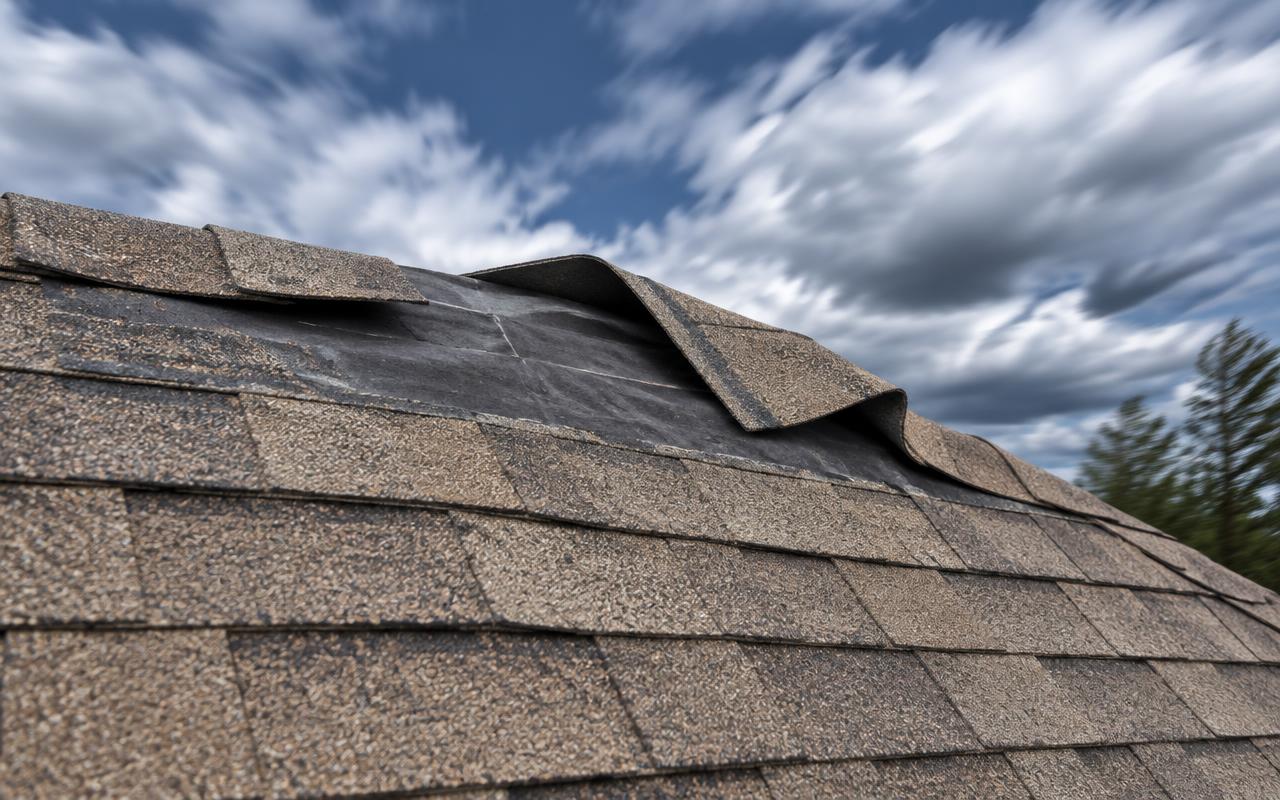
Wind uplift is when wind pulls up on a roof instead of just pushing on it. It often starts at edges, corners, and the ridge. On a home, it can break the glue strips on shingles, crease them, or tear them off. On a flat business roof, it can lift edges or pull the sheet loose. After a wind storm, a trained person should check those weak spots first.
What this page covers
This page explains how wind damages roofs and what signs to watch for. It covers both sloped home roofs and flat business roofs.
If you need to plan repairs after a storm, see our storm damage repair page for homes or our commercial storm damage page for business buildings. If hail was part of the storm, see our hail bruising page.
How wind lifts a roof
When wind blows over a roof, it speeds up as it goes over the top. Fast-moving air has lower pressure. The air inside the attic or under the roof sheet can have higher pressure. That difference pulls up on the roof.
It works a bit like an airplane wing. The roof does not fly, but parts of it can be pulled loose.
The pull is often strongest at corners, edges, and the ridge. These are the places where wind changes direction fastest.
Wind on shingle roofs
Many asphalt shingles have a strip of sticky asphalt on the back, called a seal strip. The sun warms it, and it glues the shingle to the one below. This helps hold the shingle down in wind.
Strong gusts can break that seal. Once a shingle is loose, wind can bend it back. A bent shingle may crease, which leaves a line across it. A creased shingle may stay in place but no longer lie flat or shed water well.
In stronger wind, shingles can tear off. Then the layer underneath, called underlayment, is exposed. Underlayment is a backup layer and is not meant to face sun and rain for long.
Signs of wind damage on homes
- Shingles missing, often near edges, corners, or the ridge
- Shingle pieces in the yard
- Shingles that look lifted or wavy from the ground
- Ridge caps that are loose or gone
- Bent or loose metal edge pieces
- Gutters pulled away from the house
Look from the ground only. Use your phone's zoom. Take photos.
Creased shingles are hard to see from the ground. A trained person on the roof can check by looking for lines across shingles and gently testing if they are still sealed.
Why older roofs lose more
As shingles age, they can get brittle. Seal strips can weaken. Nails can back out a bit over time.
A roof that held up well in wind when new may lose shingles in the same wind years later. This does not always mean the roof is at the end of its life. It does mean it should be checked after big storms.
How shingles are fastened matters
Shingles are held by nails in a certain zone on each one. If nails are too high, too low, or too few, the shingle may not hold as well in wind.
Shingle makers print nailing rules on their packages. Roofers who follow them help the roof hold up better. If many shingles blow off, ask the roofer to check how the old ones were nailed.
Wind on flat business roofs
On a flat roof, the top sheet, called the membrane, is held down by fasteners, glue, or weight. Wind can pull at the edges and corners, where the hold is often tested hardest.
Signs include lifted edge metal, seams that have opened, and areas where the sheet ripples or balloons up. A sheet that lifts and falls in each gust can pull fasteners loose underneath.
Carlisle, a large membrane maker, notes that sheets like EPDM can be held down in different ways, such as with glue, fasteners, or weight. Each way has its own wind rules set by the maker and the roof design.
Edge metal is the first line
On flat roofs, the metal along the roof edge, often called edge metal or coping, holds the sheet down at the edges. If it is loose or bent, wind can get under the sheet and peel it back.
After a wind storm, check edge metal from the ground if you can see it. If it looks bent or loose, keep people away from the area below, since pieces could fall. Have a trained crew fix it before the next storm.
Dallas wind
The National Weather Service office in Fort Worth notes that spring is the peak season for severe storms in North Texas. These storms can bring strong straight-line winds, not only hail and tornadoes.
Not every storm brings damaging wind to every home. One street can lose shingles while the next one does not.
Repairs for wind damage
For a home, wind repairs often include replacing missing or creased shingles, hand-sealing loose ones, and fixing ridge caps. Edge metal and flashing may need to be refastened.
For a flat roof, repairs may include refastening edge metal, repairing seams, and checking the fasteners under lifted areas. If the sheet lifted over a large area, the insulation below may have shifted or broken.
GAF's repair or replace guide centers on how widespread the damage is. A few spots may be repaired. Damage across many areas may point to a bigger job.
Permits and codes
The City of Dallas permit guide says home roofing work over $500 in labor and materials needs a permit. Dallas has adopted the 2021 building codes with local changes, as listed on the city's code page. These codes include wind rules for roofs.
Other cities around Dallas have their own permits and rules. Check with your city before work begins.
Insurance and wind
Whether wind damage is covered depends on your policy. Some policies treat wind and hail in their own way. Read your policy or ask your agent.
The Texas Department of Insurance says a roofer cannot act as your public adjuster or offer to cover your deductible. A roofer can give you photos and an estimate.
Questions to ask after wind damage
- Where did the roof lose shingles or lift, and why there?
- Are any shingles creased even if they stayed on?
- How were the old shingles nailed?
- Is any edge metal loose?
- What will you do to help the repair hold in the next wind?
Trees, buildings, and wind paths
Wind does not hit every roof the same way. Tall trees, nearby buildings, and the shape of the land can speed wind up or slow it down.
A home at the end of a street or next to an open field may get stronger gusts than one in the middle of a block. A roof with many angles and edges has more spots where wind can grab hold.
This is one reason two homes on the same street can have very different damage after the same storm.
Ridge vents and other parts on top
The ridge is the top line of a sloped roof. Many homes have a ridge vent there, which lets hot air out of the attic. Ridge caps, which are shingles bent over the ridge, cover it.
Wind often pulls at the ridge. If caps are loose or the vent is lifted, rain can blow in. After a strong wind, check from the ground if the ridge line looks straight and smooth. If you see gaps or loose pieces, have it checked.
Temporary steps after wind damage
If shingles are gone and rain is on the way, a trained crew can cover the area with a tarp once the wind has passed. Our emergency tarping page explains how a careful crew does this.
On a flat roof, a crew can refasten loose edge metal or put a temporary cover over an open seam. These steps buy time. They do not replace a full repair.
Getting ready for the next windy season
- Have loose or lifted shingles fixed before spring storm season.
- Ask your roofer to check that edge metal and flashing are tight.
- Trim limbs that could break and hit the roof.
- For business roofs, check edge metal and seams as part of each maintenance visit.
- Keep dated photos so you can compare after a storm.
Upgrades that may help
When a roof is replaced, there may be ways to help it hold up better in wind. Some shingles are rated for higher wind. Extra nails or special starter strips at edges can also help, when the maker allows it.
For flat roofs, the hold-down plan and edge metal can be designed for the building's wind exposure. Ask your roofer what the maker and the local code call for, and whether any upgrade makes sense for your building.
Wind and older repairs
Older repairs are often the first spots to fail in wind. Patched shingles may not be sealed as well as the originals. Sealant around vents can dry out and crack.
After a wind storm, ask the roofer to look closely at any past repair areas. If they fail often, a better fix may be needed.
Wind on metal roofs
Metal roofs can also lose panels or trim in strong wind. Screws can loosen over time. Edge trim and ridge caps may lift first.
Signs include bent trim, loose or missing screws, and panels that rattle. A trained crew can refasten or replace parts. Do not go up to check yourself.
Wind signs and what they may mean
| What you see | What it may mean |
|---|---|
| Shingles missing near edges | Wind uplift at the weak zone |
| Ridge caps gone | Wind at the top of the roof |
| Wavy shingles from the ground | Seals may be broken; get them checked |
| Bent edge metal on a flat roof | Wind got under the edge; fix soon |
| Sheet ballooning in wind | Hold-down may have failed; get help |
| Many shingles gone on an old roof | Ask about repair versus replacement |
Common questions
- Can a shingle be damaged if it stayed on?
- Yes. It can be creased or lose its seal. It may no longer lie flat or shed water well.
- Will new shingles stay on better?
- New shingles that are nailed and sealed by the maker's rules usually hold better than worn ones. No roof is wind-proof.
- Should I hand-seal my own shingles?
- No. Stay off the roof. A trained person can hand-seal loose shingles safely.
- Why did only one side lose shingles?
- Wind often hits one side harder. Shape and nearby trees or buildings also change how wind moves.
- Is a ballooning flat roof dangerous?
- It can be a sign the hold-down has failed. Keep people off the roof and away from edges, and get a trained crew to check.
- How soon should wind damage be fixed?
- Before the next rain if possible. Exposed underlayment or a loose edge can let water in or get worse in the next wind.
What happens if you send a request here
This site is a preview. The request form is not connected, so nothing you type is saved or sent. No local roofing partner is confirmed yet, so we cannot promise a visit, a price, or a time. If anyone is in danger, call 911. How this site works.
Sources
- National Weather Service Fort Worth — DFW climate narrative
- Carlisle SynTec — EPDM membranes
- GAF — Should you repair or replace your roof?
- City of Dallas — Development Services permit guide
- City of Dallas — Know the Code (adopted codes and amendments)
- Texas Department of Insurance — Roofing and insurance: know the law
Sources checked October 5, 2026. Confirm current rules before acting.