Guide · Informational preview
What Is a Composite Roof? Find Out What the Name Means
Composite roof is a broad label, not one exact roof product. Some makers use composite or composition for asphalt shingles. Other roof products use polymers. That is a broad group of materials which includes plastics. Ask for the brand, model, and material before you compare price, care, or repair. The word on its own cannot settle those choices.[AG06][AG07]
Informational preview. No Dallas roofing provider, service coverage, phone, or working intake has been verified.
Review status: Original educational draft. Named author and qualified roofing review are pending.
Why one word can send you down two paths
CertainTeed calls asphalt shingles composition or composite shingles in its roof guide. It explains that they combine a mat, asphalt, and mineral grains. In that source, composite does not mean a separate high-end slate-look product. The term names a blend of materials.[AG06]
QAI uses the word in a different way. Its listing covers named DaVinci roof products. QAI tests products and lists those that meet its rules. Its listing calls those named composite products polymeric. That word tells you the group of materials used. The listed models include shake and slate styles. This example does not define every composite roof.[AG07]
Both uses are real. That is why a search result or a two-word bid line can be unclear. Ask the person who used the term what they mean. Do not correct them based only on the definition you found first. Match the term to a product you can check.
Your goal is a name that leads to the right records. You do not need to master roof chemistry. You need enough detail to know which guide, care plan, and replacement part applies. Start that check before a vague label turns into a signed order.
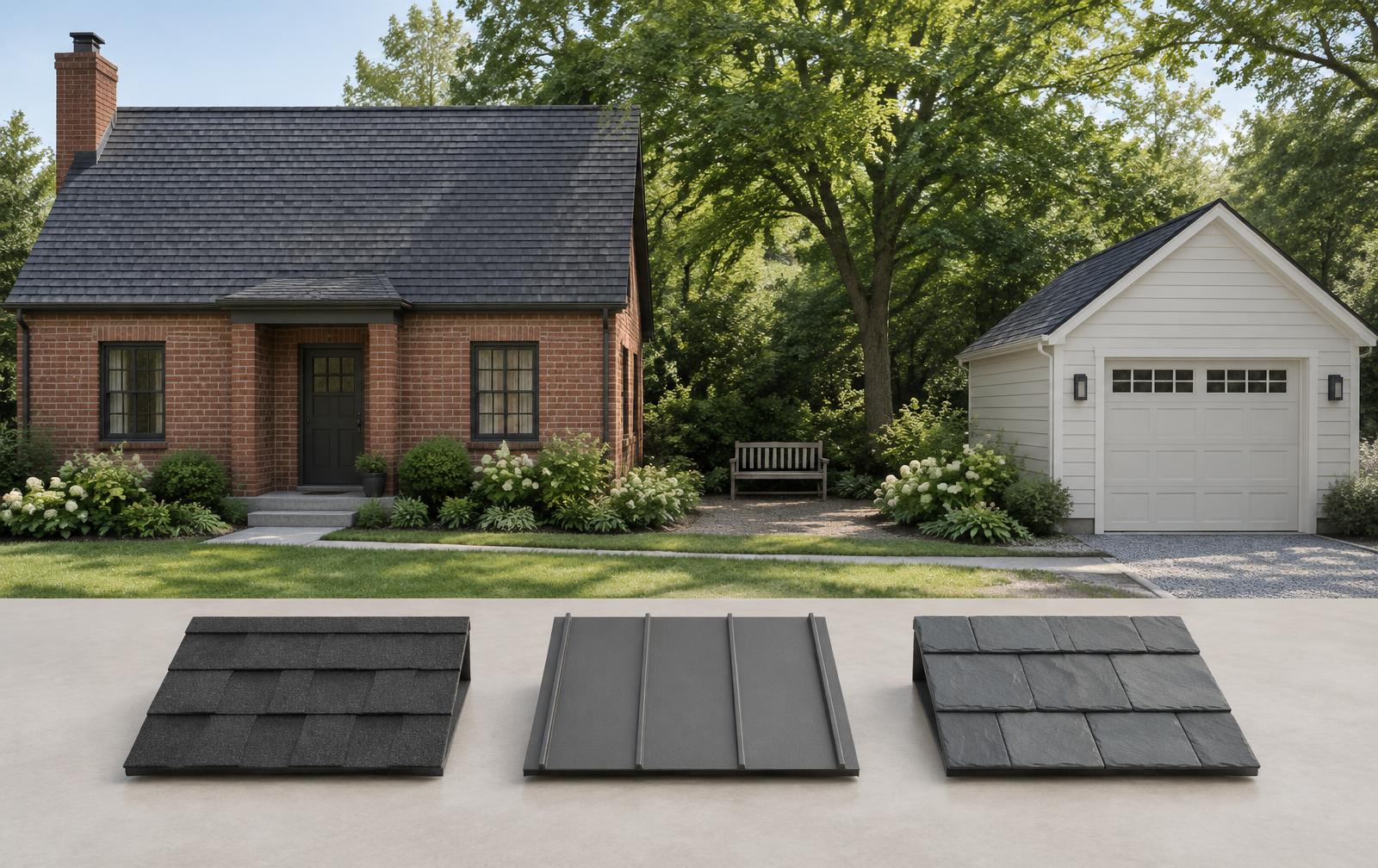
- Composite: which product?
- Named asphalt product
- Named polymer product
- Material
- Model
- Maker
- Right roof area
Shape alone does not identify a material. Unknown names stay unknown until supported by a record.
Illustrative planning diagram, not a measured report or official form.
Separate material, shape, and product name
A roof description can answer three different questions. Material tells you what a piece is made from. Shape tells you the look it was formed to have. The product name tells you which exact line the maker sells. Keep all three fields in your notes.
For example, shake can describe a look as well as wood roofing. Slate can mean natural stone or a slate-like shape. CertainTeed describes asphalt designs that copy those looks. QAI lists polymer products with shake and slate in their names. A style word does not settle the material.[AG06][AG07]
Ask a bidder for three short answers. Who makes it? What is the full model name? What is it made from? Leave color on a fourth line. A color called stone gray does not turn the piece into stone.
Do the same for the roof already on your home. A seller's listing may use a short label for convenience. Keep it as a lead to check, not the final answer. Keep the old label until you have stronger proof. Note why and when you change it.
Read the asphalt clues with care
GAF describes the parts in a common asphalt shingle. It has a fiberglass base, asphalt, and grains on its face. Fiberglass names the mat that supports the shingle. It does not mean the roof is made only of glass. A grain-covered face can fit that type. Still, looks alone are not enough.[AG08]
The word architectural needs a check too. CertainTeed uses that word for a type of asphalt shingle. It calls the same type dimensional. That term alone does not establish a molded polymer product. Ask for the maker's sheet. A name that sounds high-end does not tell you what is inside.[AG06]
If records confirm asphalt, follow the asphalt shingle guide for system and repair questions. This page will not repeat that full choice. Its job is to help you get to the right material guide with a clear product name.
If the records only say fiberglass composite, ask one more question. What holds the piece together, and what coats its face? Have the supplier point to the maker's description. Keep the answer in plain words beside the label. A later owner should be able to follow it.
Watch: What Is a Composite Roof? Find Out What the Name Means lesson
Captions will appear here when the video plays.
41 seconds, silent. No narration: on-screen captions carry the message. Silent, caption-led AI teaching footage and editor-made graphics. Not a real property, job, test, inspection, approval, service or credit offer.
Chapters
Read the caption transcript
Composite is a roof label that needs one more question: which product? Some makers use the word for asphalt shingles. Other named composite products use polymers.
Shape is a separate clue. A slate or shake look does not settle what a piece is made from.
Match three facts: material, model, and maker. Then tie them to a record for the right roof area. A garage bill may not describe the main house.
Do not climb or damage a sample to test it. Keep unknowns clear, and use the exact product name before you compare bids, care rules, or repair parts.
Do not use polymer as a shortcut either
Polymer names a broad group of materials. It is not a single recipe or a quality score. One GAF product, ArmorShield II, blends a polymer into asphalt. So the word polymer in a brochure does not, by itself, prove that the shingle is an asphalt-free molded product.[AG09]
Ask what the maker calls the whole product. Then find the sheet for that exact model. A feature in one layer should not be used as the name of the entire roof. Likewise, recycled content is a separate claim to check. Do not infer it from composite or synthetic.
For a confirmed synthetic slate option, the slate and synthetic roof guide goes further into that choice. It compares the owner questions around those systems. Use it after you know which material the offer actually names.
Avoid broad claims that all plastic-based roofs behave the same. A product label cannot set a life span, test result, or care method for a whole family. Ask for current, product-specific evidence for each claim that would change your decision.
Build a trail from roof to named product
Start with documents already in your files. Look for a final product list, invoice, warranty record, or saved package label. Write down who created each record and when. An order list may show what was planned. A final delivery or job record may help show what was used.
If you can reach the last owner or roofer, ask them. They may have the missing product details. Keep the request narrow. You need the brand, model, and place used on the roof. You do not need their private payment or claim files. Keep the request focused on the roof name.
If you have a spare piece, keep it intact and show it safely to a trained person. Note where it came from. Do not scratch, burn, cut, or bend it as a home test. Do not climb or lift installed roof pieces to hunt for a stamp.
Ask how sure the roofer is about the name. A name found on a label is one kind of proof. A likely match based on shape is a weaker clue. Both may help, but they support different decisions. If two facts clash, keep both in view and ask what would resolve the mismatch.
Make a mixed roof easier to name
Do not use one roof label for the whole property. A home, porch, and detached garage can have different coverings. Even one roof may have been repaired in stages. Mark these parts on a simple ground-view sketch before asking about the whole roof.
Here is a made-up example. A house file says composite roof. A later garage bill names an asphalt shingle. A spare slate-look piece sits in a shed with no label. None of these facts proves the material on every roof face.
The owner creates three entries: main house, porch, and garage. The garage entry keeps the bill and its date. The spare piece stays unassigned until its source is known. The house and porch need further checks. This is more useful than turning one uncertain clue into a property-wide fact.
For each zone, add the evidence, confidence, and next question. We made this naming aid to help you plan. It is not an official roof test. It helps a roofer see where your records are strong. It also prevents an old garage document from driving a new house order.
Use ratings to check a claim, not fill a name gap
A class or test badge cannot replace the product name. QAI's DaVinci listing sets out named products and roof assemblies. An assembly is the full tested set of roof parts. Its table includes the base, lower layers, covering, and limits. Those details matter when checking that listing.[AG07]
Ask which model and full roof build the seller's claim covers. Is the document current? Does it cover the material and method in this offer? Do not choose a listed build from this article. A qualified project team must check the fit and the local requirements.
Keep different claims on separate lines. A fire claim, an impact claim, and a warranty promise answer different questions. One badge should not be used as proof of all three. Ask the source for the exact meaning if the bid blends them into one vague phrase.
A qualified roof team can review the rating's details. Here, the useful step is to attach each claimed rating to a named product and document. If that connection is missing, record the gap before treating the claim as verified.
Worked example
Fix vague bid wording before choosing a price
A bid that says install composite shingles may leave the core choice open. Ask for the exact brand, model, color, and roof area. Could the firm use a different product instead? If so, how would you review and approve that change before it reaches the roof?
Imagine two offers with that same short phrase. One firm means an asphalt shingle. The other means a molded shake-look product. Comparing the totals as though they buy the same roof would be misleading. First make the material and the full work clear. Then compare the prices.
Ask each firm to state what is included below and around the covering. A named top layer still leaves roof joints, base repairs, and removal scope to resolve. The roof bid comparison guide handles that wider review. The naming check is one early step in it.
Do not rewrite the bid yourself and assume the firm agrees. Ask for a revised offer. Save the new date and version. If the firm cannot yet name it, keep that choice open. An open choice is more honest than a guess that looks final.
Turn identification into the right next question
Once the product is known, pick the guide or expert that fits the task. Are you trying to buy a new roof, repair one area, or plan care? Those are different questions. A roof-type guide cannot tell you if a damaged joint can be fixed.
For a repair, ask how the proposed piece matches the old product. Does the source confirm fit, or just a similar look? For care, ask which current instructions apply to the installed model. For a new roof, ask how the full assembly suits the building.
If the line is no longer sold, note that fact and its source. Do not assume a current model with a similar name has the same fit. Ask the maker or a qualified roofer what evidence supports the next step. An old line may no longer be sold. That alone does not prove the whole roof must go.
Keep the updated product record with your home files. That saves the next person from repeating the naming puzzle. It also makes warranty questions more focused. Use the roof warranty guide when you need to read the actual coverage and limits.
Make your roof name check
| Item | Review notes |
|---|---|
| 1 | For each roof zone, write what the papers call it. Then add what it is made from and its full name. On a fourth line, note the proof behind that answer. Add unknown where needed. Keep the source link or label photo beside the fact it supports. |
| 2 | Then write one question that would close the biggest gap. For example: which model does this bill refer to on the main house? Send that question to the right source. You now have a practical next step without trying to choose a roof from a loose word. |
Common questions
- Does composite mean recycled?
- No. The label alone does not state recycled content. If that feature matters to you, ask the maker for proof. Get the sheet for the exact model. Check which product and part the claim covers. Do not assume every model from a brand has the same ingredients or content.
- Can I identify my roof from a phone photo?
- A photo may narrow the search. It may not show the material, back markings, or hidden build. Use it with records and a safe expert check. Ask what the image proves and what is still a guess. Get those answers before you order a matching part.
- Is one composite roof always better than another?
- There is no sound answer from that label alone. Name both products and define the job first. Then compare the relevant evidence, full scope, and care needs. We do not rank these roofs or set one price for them. A shared label cannot tell you how long each roof will last.
Next step
Use the question sheet to prepare your own review.
Make your roof name checkSources
- [AG06] CertainTeed: Types of asphalt roofing shingles (dated 2026-10-06)Limit: Maker explicitly uses composition/composite for asphalt; mixed ingredients; architectural/dimensional asphalt styles can resemble shake or slate. Current manufacturer HTML retrieved from Canadian site. Naming/material evidence only, not a Dallas code, availability, price, warranty or coverage source.
- [AG07] QAI: Westlake DaVinci Roofscapes listing B1050 (dated 2026-10-06)Limit: Named composite roof products are polymeric; slate/shake names; listing identifies models and full assemblies. Current public issuer listing retrieved, marked revised August 18, 2025. Limited to naming and assembly-specific nature. No test result or local acceptance claimed. Page has an apparent impossible effective-date typo (June 31, 2012); not repeated or relied upon. Manufacturer product page returned 403; that denial was respected, with no alternate endpoint used. The independently hosted issuer listing was already discovered as a separate primary source.
- [AG08] GAF: What are shingles made of? (dated 2026-10-06)Limit: Common asphalt shingles combine fiberglass base, asphalt and mineral grains. Current full HTML retrieved following official redirect from old article URL. Dated November 27, 2024. Composition only; no market-share, life, comparative performance or affordability claims adopted.
- [AG09] GAF: Timberline ArmorShield II material description (dated 2026-10-06)Limit: Named example mixes a polymer into asphalt; polymer alone does not establish an asphalt-free product. Current manufacturer HTML retrieved. Used as a counterexample about terminology only. Performance, test, installation and warranty promises are not generalized.
Source dates and limits are listed above. Confirm current rules and actual terms with the responsible office or qualified adviser.