Roof Problems · For homeowners
Hail Bruising: Damage You Can Feel More Than See
Quick answer
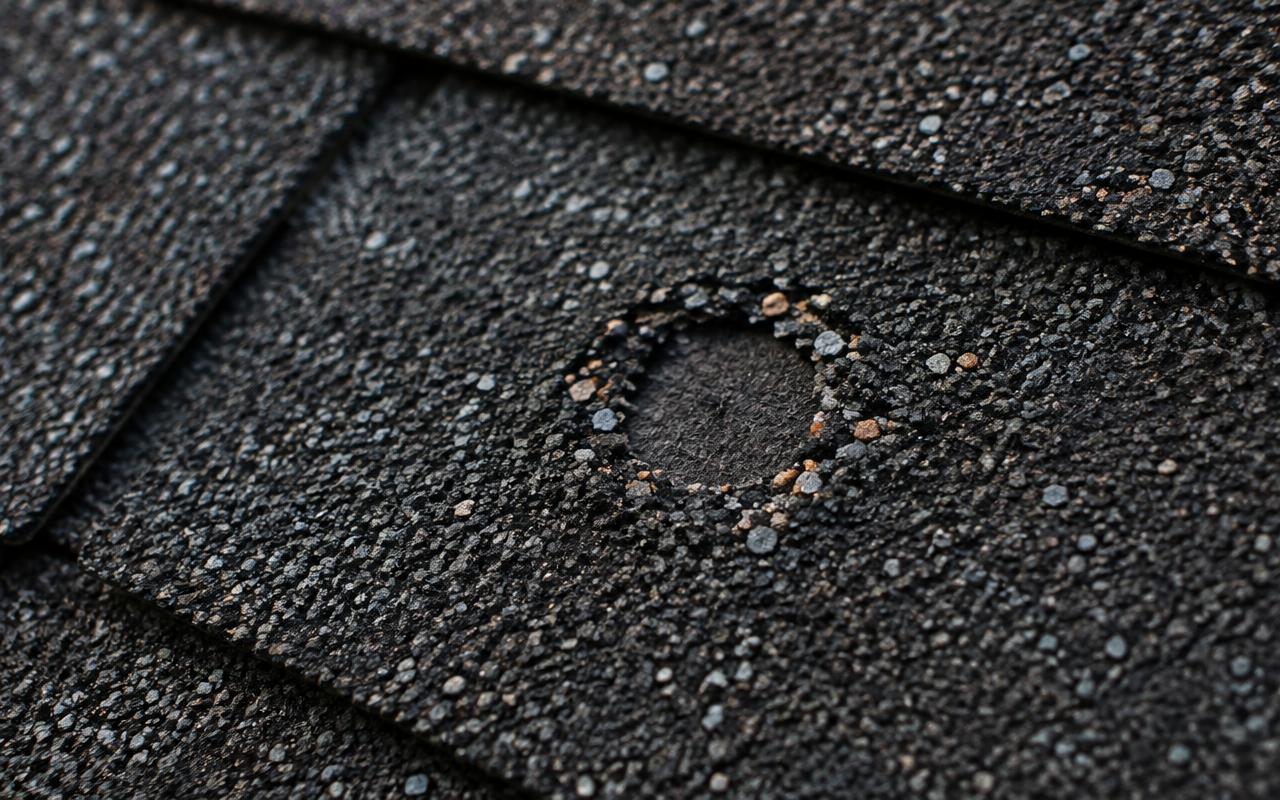
A hail bruise is a spot where hail hit a shingle hard enough to hurt it under the surface. It often looks like a round spot with stones knocked off. It may feel soft when pressed. Not every round mark is a bruise. Heat blisters, foot scuffs, and old wear can look alike, so a trained person should check and explain each mark.
What this page covers
This page explains what a hail bruise is, how it differs from other marks, and why it matters. It is about the mark itself.
If you want to know how a full hail inspection works, see our hail damage inspection page. If you want to plan repairs after a storm, see our storm damage repair page.
How a shingle is built
An asphalt shingle has a thin mat, often made of glass fibers. The mat is soaked in asphalt, which is a thick black oil product. Tiny colored stones, called granules, are pressed into the top.
The granules shield the asphalt from the sun. Without them, the sun dries out the shingle faster. That is why losing granules matters.
What a bruise is
When a hailstone hits a shingle, it can do a few things. It can bounce off with no harm. It can knock off granules. Or it can crush the mat under the surface.
A bruise is the last case. The mat under the spot is weakened, even if the top looks only scuffed. Some people describe it as feeling like a soft spot on an apple.
Over time, a bruised spot may crack or lose more granules. It may not leak at first. That is why bruises can be easy to miss.
What bruises often look like
- A round or oval spot, often darker than the shingle around it
- Granules knocked away, showing the black asphalt or the mat
- Marks spread at random across a slope, not in lines
- More marks on the side of the roof that faced the storm
- Sometimes a slight dent or softness when pressed gently
Fresh bruises can look shiny where the asphalt shows. Older ones can look dull. Size and spacing vary with the storm.
Marks that are not hail
Several other things leave marks on shingles. A careful inspector will tell them apart.
Heat blisters form when small pockets in the shingle swell in the sun and pop. They leave small pits, often in groups.
Foot scuffs come from people walking on the roof. They tend to be in paths near ladders, vents, or the ridge.
Normal wear shows as even granule loss over the whole roof, often more on the sunny side. Cracks from age often run in lines.
Damage from tools or objects can look sharp or straight-edged. Hail marks usually do not.
Why some people disagree
Even trained people can disagree about a mark. Bruises can look like other wear, and older marks fade.
A fair inspector explains why they call each mark what they call it. They use chalk to circle marks, take photos, and often count marks in a test area. They do not call every mark hail, and they do not call every mark wear.
If two people disagree, ask each one to show photos and explain. A third opinion from someone who does not sell the repair can help.
Bruising on other roof types
Metal roofs dent rather than bruise. A dent may be only cosmetic, or it may crack the coating or bend a seam.
Tile roofs can crack, chip, or break. Wood shakes can split along the grain.
On flat roofs, hail can bruise or crack the top sheet. It can also crush the foam board under it, called insulation. A crushed spot may feel soft and can hold water later.
Why size and age matter
There is no single hail size that always causes bruises. Roof age, temperature, shingle type, and the angle of the hit all play a part.
Older shingles are often more brittle. A stone that bounces off a new roof might bruise an old one. Some impact-rated shingles are made to resist hail better, but they can still be damaged.
This is why a hail report in your area does not prove your roof is bruised, and why a small hail size does not prove it is fine.
Can you see bruises from the ground?
Usually not. Bruises are small, and the color difference can be slight. You may see dents on gutters or vents, which suggests hail fell.
Do not climb up to look. Roofs are steep and slick. A trained person with safety gear should do the close check.
What happens to a bruise over time
A bruised spot may lose more granules over the next months and years. The asphalt under it gets more sun. It may crack, and water may find a way in.
How fast this happens varies. Some bruises stay stable for a long time. Others get worse sooner. A roofer cannot promise exactly when a bruise will leak.
Repair options for bruised shingles
If only a few shingles are bruised, they can often be replaced one by one. The roofer should match the color and type as closely as they can.
If many shingles on many slopes are bruised, a larger repair or a new roof may make more sense. GAF's guide says the choice depends on how widespread the damage is.
Ask the roofer to explain why they suggest a repair or a bigger job. Ask for photos of the marks they counted.
Insurance and bruises
Whether bruises are covered depends on your policy and your insurer's findings. A roofer cannot promise that a claim will be paid.
The Texas Department of Insurance says a roofer cannot act as your public adjuster or offer to cover your deductible. Keep your own photos and the roofer's report. Our Texas claim guide explains the roles.
Questions to ask about each mark
- Why do you think this is hail and not a blister or scuff?
- Did it feel soft when you pressed it?
- How many marks did you count on each slope?
- Are the marks spread at random?
- Do soft metal parts on that side also show dents?
How a trained person checks a mark
A careful inspector does not judge a mark by looks alone. They use a few steps to build a clear picture.
- They look at the mark in good light, often from more than one angle.
- They gently press near it with a gloved thumb to feel for softness, done only by trained people.
- They check nearby shingles to see if the marks repeat in a random pattern.
- They compare the slope that faced the storm with slopes that did not.
- They check soft metal on the same slope for dents that match in size.
- They photograph each mark next to a ruler or tape so size is clear.
This adds up to a fair story about what happened. One mark alone rarely tells the whole story.
Granules in gutters
After a hail storm, you may see a lot of shingle granules in your gutters or at the bottom of downspouts. That can be a clue that hail knocked them loose.
But granules also wash off over time as a roof ages. New roofs often shed some loose granules in the first months. So a pile of granules is a clue, not proof. Take a photo of it, and mention it to the inspector.
Why the color and shine matter
When hail first knocks off granules, the black asphalt under them is often fresh and shiny. Over weeks and months in the sun, it dulls and turns gray.
This can help a trained person tell a fresh mark from an old one. It is one reason to get a roof checked soon after a storm. Months later, new and old marks can look much more alike.
Bruises and roof life
Shingles are made to wear slowly as they lose granules in the sun. A bruise speeds that up in one spot. A roof with only a few bruises may still have many good years left.
A roof with many bruises across every slope may wear faster as a whole. That is part of why the spread of damage, not just a single mark, drives the repair choice.
Bruises on a new roof
New roofs can be bruised too. If your roof is only a few years old and was hit by a big storm, it is still worth a check.
A new roof may also have a maker's warranty. Many shingle warranties do not cover hail. Check your warranty papers. Your home insurance policy is usually the place where hail damage is handled.
Living with small hail marks
Sometimes an inspector finds hail hits, but not enough to call for a repair. The marks may be shallow or few.
In that case, keep the report and photos. Have the roof checked again after the next big storm. If more marks appear, you will have a clear record of what changed and when.
Photos that help
Good photos make it easier to talk about bruises with anyone. Ask the inspector for three kinds of photos for each slope.
- A wide photo that shows the whole slope
- A middle photo that shows a group of marks
- A close photo of one mark next to a tape measure
This set shows where the marks are, how many there are, and how big they are. Photos with only close-ups can be hard to judge.
Bruises and roof color
Bruises can be easier to see on dark shingles, where the black asphalt blends in less with lost granules. On light shingles, the dark spot may stand out more.
Color alone does not tell you whether a mark is a bruise. That still takes a close look by a trained person.
Hail bruise or something else?
| Mark | Likely cause |
|---|---|
| Round spot, granules gone, soft to press | Possible hail bruise |
| Small pits in clusters | Heat blisters |
| Worn path near a vent or ladder spot | Foot traffic |
| Even granule loss over the whole roof | Normal aging |
| Straight or sharp-edged cut | Tool or object, not hail |
| Dents on metal vents nearby | Hail fell; check shingles closely |
Common questions
- Do hail bruises always leak?
- No. Many do not leak at first. They can get worse over time as the shingle loses granules and dries out.
- Can I press on my shingles to check?
- No. Stay off the roof. A trained person should do this with safety gear.
- How many bruises mean I need a new roof?
- There is no single number. It depends on how widespread the marks are, your roof's age, and the shingle type.
- Are impact-rated shingles bruise-proof?
- No. They are made to resist hail better, but large or hard hail can still damage them.
- Can bruises show up later?
- Bruises happen when hail hits. But they may become easier to see as granules wear away over time.
- Is a dent on my gutter proof of bruising?
- No. It shows hail fell nearby. The shingles still need a close check.
What happens if you send a request here
This site is a preview. The request form is not connected, so nothing you type is saved or sent. No local roofing partner is confirmed yet, so we cannot promise a visit, a price, or a time. If anyone is in danger, call 911. How this site works.
Sources
- GAF — Should you repair or replace your roof?
- NOAA National Severe Storms Laboratory — Severe Weather 101: Hail detection
- Texas Department of Insurance — Roofing and insurance: know the law
Sources checked October 5, 2026. Confirm current rules before acting.