Guide · Informational preview
Commercial Roof Cover Boards
A cover board is a firm layer under a roof sheet. It often sits on top of the insulation, which slows heat flow. The board gives the sheet a more solid base. Some boards can improve a roof system's strength or fire performance. The right choice depends on the full roof design. A board alone does not make a roof hail-proof.
Dallas Roofing Authority is an information site. A serving roofer and working request channel have not yet been verified. This page does not book a visit or save a service request.
Generic roof layer stack
- Roof sheet (membrane)
- Cover board
- Insulation layers
- Vapor or air layer, if used
- Roof deck
Learn what the board is there to do
On a low-slope roof, the top sheet keeps rain out. Roofers often call this sheet a membrane. Beneath it, foam insulation helps control heat flow. A cover board adds a tougher surface between those layers. Carlisle describes it as a way to improve resistance to pressure, foot traffic, and punctures.[C1]
That extra layer can be worth review when service teams visit the roof often. It may also be part of a tested system chosen for wind, hail, or fire goals. These are reasons to ask about a board. They are not proof that every building needs the same board or the same thickness.
Ask the bidder to state its purpose in one clear sentence. Is it there for foot traffic? Does the selected roof design require it? Is it needed for an exact test rating? If the answer is only that it makes the roof better, ask for more detail. You should know what you are buying and how that claim is checked.
Place it in the full roof stack
Ask for a side view that names each roof layer. Start with the deck, the base that supports the roof. Then find any layers that control air or water vapor. Water vapor is moisture carried in air. Next, find the insulation, cover board, and roof sheet. The chosen design may use another order or added layers.[C2]
A board below insulation can serve a distinct purpose from one above it. Even a similar-looking product may be used in another place. Ask the designer to name both the product and its job. The words roof board alone do not define a full system.
Keep this drawing with the bid. It is a simple way to spot missing scope. If one quote includes a board and another does not, compare their roof designs before their prices. Ask whether both meet the same goals. A cheaper stack may be a valid option, but you need enough detail to judge it fairly.
Know the main board choices
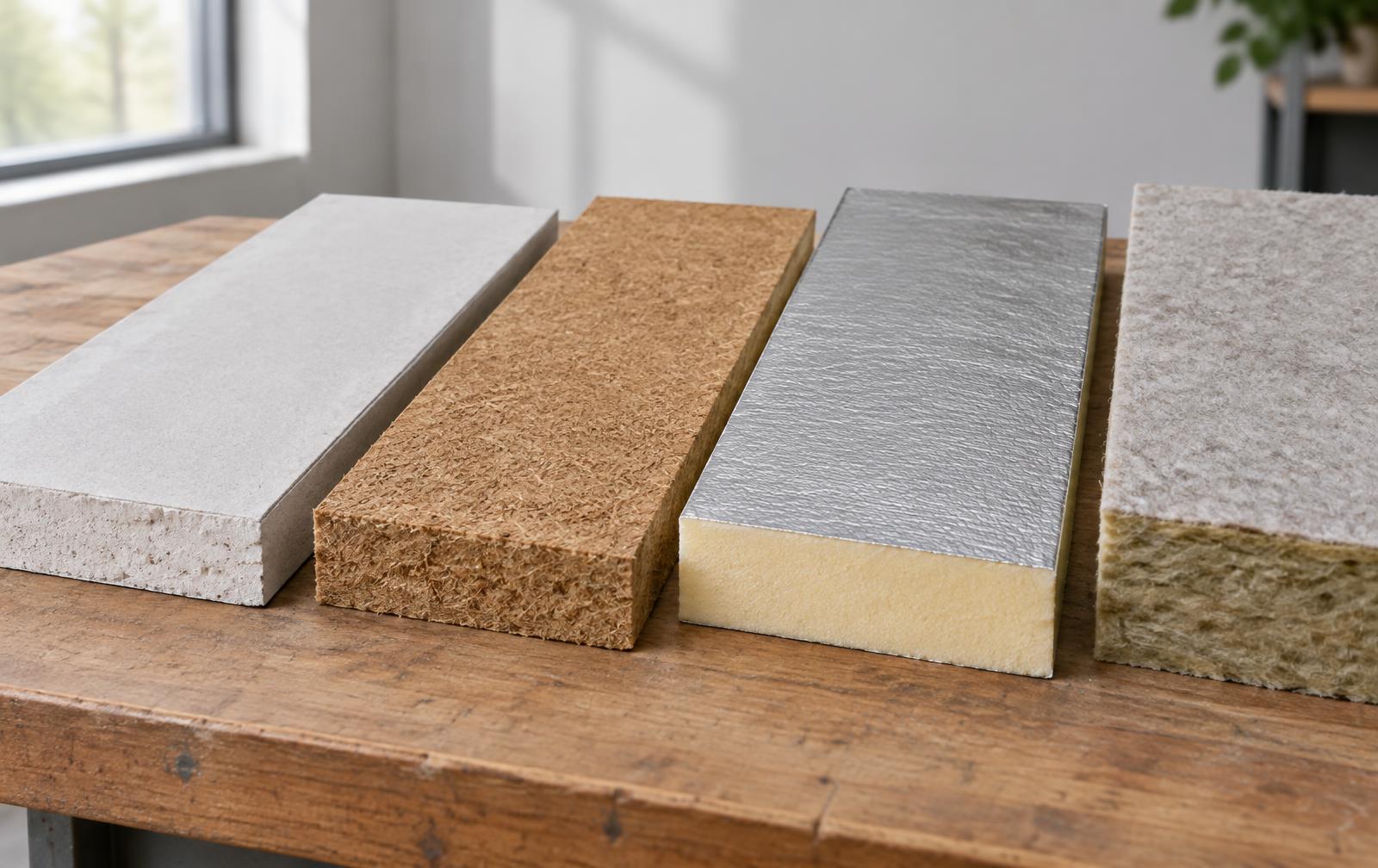
Gypsum boards use a mineral core. Some have a glass mat face. Others use fibers within the board. The exact product matters. For example, Johns Manville describes DensDeck Prime as a gypsum board with a coated glass mat face made for use with roof adhesives. That is a product-specific feature, not a rule for all gypsum boards.[C3]
High-density polyiso is a denser foam board. Polyiso is a common type of roof insulation. The dense board serves a distinct purpose from a thick layer of regular foam. JM's ENRGY 3 HD adds some heat-blocking value while giving the roof sheet a firm base. Its product data also describes a light board that can be cut to fit.[C4]
Cement and perlite boards are other options in some roof systems. Perlite is an expanded mineral. Wood-based boards also appear in some assemblies. An assembly means a tested or designed set of roof layers. Each choice has its own limits, so ask which products are allowed with your roof sheet and how they must be attached.[C1][C5]
Compare the details that change the choice
Start with the exact product names. Two bids may both say cover board yet use quite different materials. Ask for the thickness, facing, weight, and product sheet. The facing is the outer surface of a board. It can matter when the roof sheet is glued to it.
Then ask about handling and fit. Who will lift and store the boards? How will they be cut near pipes and walls? Ask how the crew will keep edges sound and surfaces ready for the next layer. These are useful bid questions even if you never handle the materials yourself.
Review the whole system's heat control as well. Some boards add more insulation value than others. That does not let you assume a thin cover board replaces all other foam. Ask the roof designer to show how the total stack meets the project's needs. Avoid choosing by one number on a product page.
Treat hail claims with care
A hail rating belongs to an exact tested system. The roof sheet, board, insulation, deck, and way they are joined can all be part of that system. JM's product listings use the phrase select systems for some hail and fire claims. That limit matters when you compare a product brochure with a bid.[C5]
Ask the bidder to supply the exact assembly record for the claim. Have them mark the products and thicknesses that match your bid. If a product changes, ask for the record to be checked again. A brand name and a hail label on their own are not enough to show a match.
Also ask what a claim does not cover. A test is not a promise that the roof can never be damaged. It does not diagnose the marks left by a past storm. Nor does it decide whether an insurance claim is covered. Keep the choice of a roof system separate from those other questions.
Read fire and wind claims as whole-system claims
Fire labels need context too. A Class A roof rating concerns exposure to fire from outside the building. It does not mean that the roof is fireproof. Nor does it tell you the hourly fire rating of the full roof and ceiling. Ask the designer for the type of rating, test, and listed roof build-up.[C6]
For wind, ask how the layers are held to the deck. A strong board does not solve a weak bond below it. Fasteners, which are screws or other anchors, and adhesives, which are roof glues, must suit the system. The single-ply attachment guide explains these choices in more depth.
You do not have to review test reports on your own. Ask the design expert to explain the matching record in plain words. Request a note that shows which parts have been checked and which are still open. That is far more useful than a folder of unlabeled brochures.
Foot traffic still needs a plan
Tell the roofer who goes on the roof and why. Name the cooling units, fans, drains, signs, or other items that need care. Show which items need frequent visits. A board hidden below the roof sheet does not tell a service worker where to walk.
Ask whether the roof also needs compatible walk pads. These are surface pads meant for service routes in approved systems. Plan the route from the access point to each work area. Include the side of each unit where the service panels open. A path that ends at the wrong side will not match how the roof is used.
Cover boards and walk pads do not replace fall protection. Qualified people must assess roof edges, hatches, and skylights for safety. The roof access and walkway guide can help you prepare that discussion. Staff should not go up simply to check whether a cover board is present.[C7]
Ask how the roof's condition will be checked
For an old roof, start with what is already there. Ask the roofer to name the known layers and explain how they were found. Request the findings from any planned test openings. Make sure the roof is sealed after checks. Hidden layers should not be guessed from the color of the top sheet.
Ask what happens if the team finds wet foam, a soft base, or poor attachment. A new board can hide a surface from view. It does not prove that the old layer is fit to stay. Have the bid name the checks needed before the new assembly can be approved.
If only one area needs a repair, ask how the new board will meet the old roof. A patch may need a local detail rather than the same design as a full replacement. Have the roofer explain what must be opened and how the edge will be sealed. Keep this scope clear so a small repair does not drift into an undefined project.
Get an itemized choice you can compare
Ask for one base proposal and any real alternatives. Each option should name the full roof system. Have the bidder explain what changes with each board choice. Does it change weight, attachment, handling, or test listings? Ask which other lines in the quote must change with it.
Review labor and access along with material cost. A heavy board may need different handling from a light one. A roof full of small curbs may take more cutting than an open roof. Ask which facts were used for the estimate. Avoid treating a generic price per board as your installed cost.
Keep product approval separate from warranty coverage. Ask for the real proposed warranty and read its limits. A longer term is not proof that all kinds of damage are covered. Have the roofer explain who handles a claim and what records the owner needs to keep. No warranty has been verified for your roof by this guide.
Check substitutions before they reach the roof
Supply changes can lead to another board being offered. Ask for notice before a swap. Request its exact name and the reason for the change. Have the design team check the full assembly again. A product with similar thickness may not have the same approved uses.
Use a simple written decision record. List the original item, proposed item, affected drawings, and who reviewed the change. Include any price or schedule effect. This keeps everyone working from the same scope and makes it easier to resolve a question at closeout.
Ask for delivery photos or labels to be kept with the project file. During work, request a few clear photos before the roof sheet hides the boards. At handoff, compare that record with the approved product list. This is a practical owner check; it does not replace field review by the roof professional.
Turn your roof use into the next step
Before asking for quotes, write down what matters most on your building. You may need frequent service access, an exact tested system, or tighter limits on added weight. Share those needs along with the roof plan. Ask the roofer to explain whether a cover board helps and which complete design supports that answer.
If slope is also being changed, review tapered roof insulation as its own part of the design. If fire claims drive the choice, read the roof fire rating guide. Each topic answers its own question. Together, they help you compare a planned roof without treating one board as the answer to every concern.
Common questions
- Does a thicker roof sheet remove the need for a board?
- Not by itself. The sheet and the board do different jobs. Ask whether the full design allows the board to be left out. Then compare the test records and use limits of both options. Do not assume one thicker layer makes the rest of the design the same.
- Can a board make any roof safe for heavy equipment?
- No. Equipment loads need a structural review and proper supports. A firm layer under the sheet is not a new deck or a beam. Tell the designer about planned equipment before the roof system is chosen.
- Are all gypsum roof boards alike?
- No. Core, facing, thickness, and approved uses can differ. Ask for the exact product named in the bid. Have the team show that it fits the chosen roof system rather than rely on the general word gypsum.
- Should I buy the board with the highest test claim?
- Choose a complete design that meets your building's needs. A label has little value if its tested system does not match your roof. Ask which claim is relevant, what it means, and how the planned work will match it.
- Can I add a cover board without replacing the roof sheet?
- A cover board normally goes below the sheet, so access to that layer is part of the work. Ask a roofer to explain what would be removed and rebuilt. It is not usually a surface add-on that an owner can place on a finished roof.
Next step
Write down roof traffic, planned equipment, and any required test ratings. Ask each bidder to name the board, its purpose, and the full roof assembly.
List your cover-board needs(opens official site in a new tab)Sources
- [C1] Carlisle: The Role of Cover Boards in Commercial RoofingLimit: 2020 overview; exact approved assembly governs.
- [C2] GAF: Understanding the Layers of a Single-Ply Roofing AssemblyLimit: Illustrative layer order is not universal.
- [C3] Johns Manville: DensDeck Prime Roof BoardLimit: Example only; no claimed endorsement, certification or installed project.
- [C4] Johns Manville: ENRGY 3 HDLimit: No universal thickness, R-value, or fastening schedule prescribed.
- [C5] Johns Manville: PVC Roofing SystemsLimit: Catalog inclusion does not approve every listed board in every PVC assembly.
- [C6] UL: Class A, B, and C Roof Ratings (2014 article, 2015 reprint)Limit: Older explanatory source only. Does not establish present Dallas requirements.
- [C7] OSHA: Solar Energy FallsLimit: No specific OSHA distance or universal fall-protection design is prescribed.
Sources checked October 5, 2026. Confirm current rules with the city before work starts.